Why Your Shoulders Round Back By 3PM Even After a Great Morning Stretch
Quick Answer: Your posture collapses by afternoon because muscles fatigue on a timer your stretching doesn’t touch — the deep postural stabilizers tire around hour 4-5 of sitting, regardless of how tall you started. Fixing it takes load-bearing breaks, not more stretching.
You did everything right this morning: rolled your shoulders back, held a stretch, sat up straight at your desk. By 2:45pm you catch your reflection in a dark monitor and you’re a question mark again. This isn’t a willpower problem, and it isn’t happening because you forgot to sit up straight. It’s a fatigue problem, and it has a fix your stretching routine was never built to deliver.

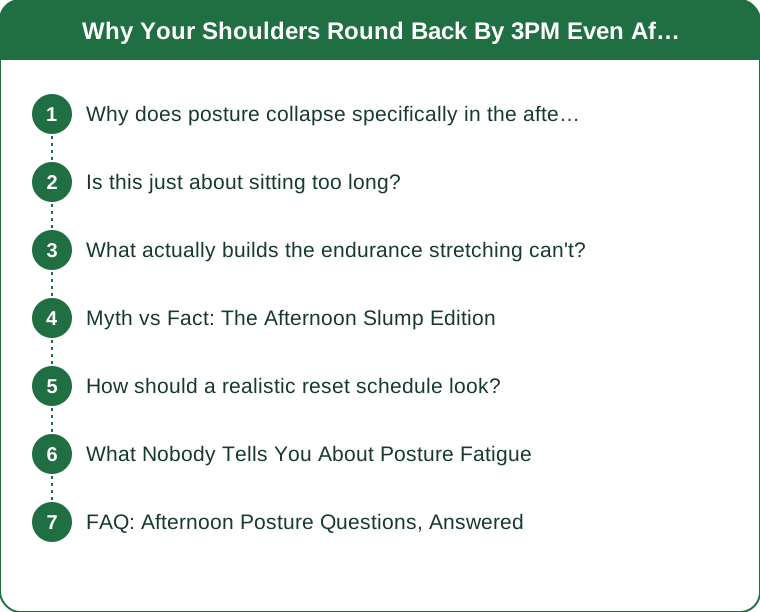
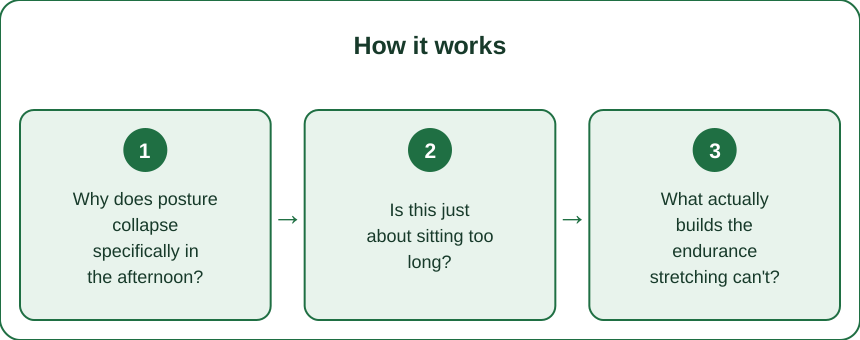
Why does posture collapse specifically in the afternoon?
Postural muscles — the deep neck flexors, lower traps, and spinal erectors — are endurance muscles, built for holding low-level tension for hours, not bursts of effort. Endurance muscle fatigues on a slow curve: strong at hour 1, noticeably weaker by hour 4, close to empty by hour 6.
A morning stretch lengthens tissue and feels great for about 20 minutes, but it does nothing to build the endurance capacity of those postural muscles. It’s like stretching your calves before a marathon and expecting that to replace training. By early-to-mid afternoon, the muscles that were holding your ribcage over your pelvis simply run out of gas, and your skeleton falls back on ligaments and momentum instead — which is what a slump actually is.
Is this just about sitting too long?
Sitting duration matters, but unbroken sitting duration is the real variable. Research on postural endurance consistently shows the fatigue curve resets meaningfully with movement breaks as short as 60-90 seconds, taken every 30-40 minutes.
Most people don’t slump because they sat 8 hours — they slump because they sat the same 8 hours without a single postural reset. Two people with identical desk hours can have completely different afternoon posture depending on whether one of them stood up 12 times and the other stood up twice.
What actually builds the endurance stretching can’t?
Isometric holds under light load — not stretching, not mobility work. A wall-supported shoulder blade squeeze held for 30-45 seconds, done 3-4 times through the day, trains the exact fatigue-resistant fibers that keep you upright at 3pm.
A simple version: stand with your upper back against a wall, arms at 90 degrees like a goalpost, and press the backs of your hands into the wall for 30 seconds. Do it once after lunch specifically — that’s the window right before the biggest afternoon fatigue drop, and pre-loading the muscles there blunts the collapse by a couple of hours.

Myth vs Fact: The Afternoon Slump Edition
Myth: More stretching in the morning prevents afternoon slumping. Fact: Stretching addresses tightness, not endurance. You can be perfectly flexible and still collapse by 3pm because flexibility and postural stamina are different systems entirely.
Myth: A posture corrector brace fixes this. Fact: Braces train the muscles to rely on external support, and most people report feeling weaker without the brace within 2-3 weeks — the opposite of the goal.
Myth: Standing desks solve afternoon slumping automatically. Fact: Standing without alternating positions just moves the fatigue curve to your lower back and feet instead of your upper back. The fix is alternating and taking breaks, not the furniture.
How should a realistic reset schedule look?
Think in three checkpoints, not constant vigilance:
- 10:30am — a 90-second movement break (stand, reach overhead, walk to refill water)
- 1:00pm (right after lunch) — the wall press-back hold, 30-45 seconds x 2
- 3:30pm — a 2-minute walk, ideally outside or at least away from the screen
That’s roughly 5 minutes of total intervention spread across a workday, timed to hit the fatigue curve before it bottoms out rather than after you’ve already noticed you’re slumped.
What Nobody Tells You About Posture Fatigue
Here’s the part most posture advice skips: the collapse itself isn’t dangerous — the pattern of never interrupting it is. An hour of slumped sitting is not going to hurt you. Six straight hours of it, every single day, with zero breaks, is what turns into the chronic rounded-shoulder pattern people spend years trying to undo.
The goal was never ‘perfect posture all day.’ It’s breaking up the duration of poor posture so no single stretch of slump lasts long enough to become the new normal your body defaults to.
FAQ: Afternoon Posture Questions, Answered
Why does my posture feel worse on meeting-heavy days?
Back-to-back meetings remove your natural excuse to stand (walking to talk to someone, grabbing coffee), so the unbroken sitting stretch gets longer without you noticing — often 2-3x longer than a normal work block.
Does core strength fix afternoon slumping?
It helps but isn’t the whole answer — core strength supports your spine when you’re moving. Slumping happens in stillness, which is a postural-endurance problem specifically, not a strength problem.
How long until the wall-press habit actually changes my posture?
Most people notice their 3pm reflection looking better within 2-3 weeks of consistent midday holds — postural endurance builds faster than most strength gains because you’re training a system that’s already active all day, just underloaded.
TL;DR:
- Afternoon slumping is a fatigue problem in endurance muscles, not a flexibility problem
- Stretching alone can’t fix it — isometric holds like the wall press-back can
- Time your resets to the fatigue curve: mid-morning, right after lunch, mid-afternoon
- The goal is shorter slump durations, not zero slumping ever
Skip the extra stretching tomorrow and try the 1pm wall press instead — it’s the one intervention timed to actually meet the collapse before it happens.
Keep Reading
This article is for general informational and styling purposes only. Fit, sizing, and product availability may vary.