The Complete Guide to Posture on Long Journeys: Cars, Planes, and Trains
Quick Answer: Travel posture problems come from duration and constraint, not from bad sitting technique. A car seat reclines your pelvis and loads your low back; a plane seat pushes your head forward and loads your neck; a train seat is usually the best of the three but has the most movement and vibration. The reliable fixes are the same in every seat: support behind the pelvis, not the ribs, get your head back over your shoulders, and change position every 20 to 30 minutes. Movement beats posture on any journey longer than an hour.
Most travel-posture advice tells you to sit up straight. On a five-hour journey, nobody sits up straight, and telling yourself to is not a plan.
This is a plan for what actually happens instead.
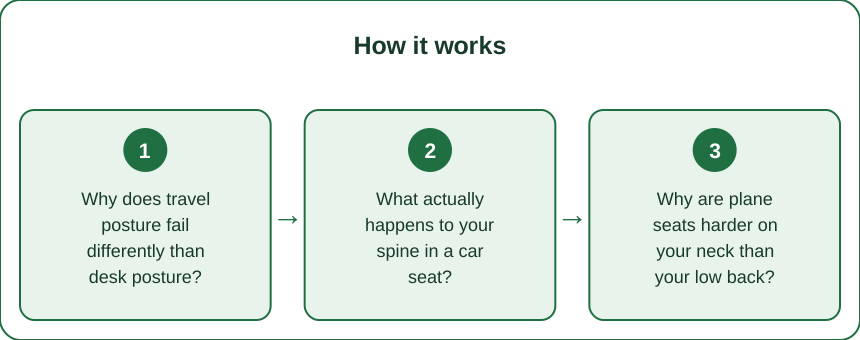
Why does travel posture fail differently than desk posture?
Because at a desk you have control, and in a vehicle you do not.
At a desk you can change your chair height, move your monitor, stand up whenever you like, and adjust the whole setup to you. Almost every desk-posture recommendation depends on that control.
In a vehicle, the seat is fixed, the seat shape was designed around an average that is not you, and standing up ranges from awkward to impossible. On top of that, three things are working against you that a desk does not have:
Vibration. Continuous low-frequency vibration — worst in cars and coaches — causes the deep stabilising muscles of the spine to fatigue measurably faster than static sitting does. This is one of the better-established findings in occupational health research on professional drivers.
Restricted movement. You cannot shift as freely, so you spend far longer in each individual position.
Duration. A five-hour journey is longer than most people sit continuously at work.
So the goal changes. At a desk, you optimise a position. On a journey, you manage a sequence of positions, and you accept that none of them will be perfect. The person who arrives feeling fine is not the one who sat best. It is the one who moved most.
What actually happens to your spine in a car seat?
The pelvis rolls backwards, and everything above it follows.
Most car seats — particularly in lower, sportier cars — place the seat base lower than the knees and add a reclined backrest. That combination tilts the pelvis into posterior tilt, which flattens the natural inward curve of the low back. A flattened lumbar spine loads the front of the discs more and the supporting muscles less, and after ninety minutes that shows up as the familiar dull ache just above the belt line.
Then there is the driver-specific asymmetry. Your right leg works the pedals, your left often braces against the footwell, and your right arm reaches to the wheel more than your left. Over hours, the pelvis rotates slightly and one side of the low back does more work.
What genuinely helps in a car:
- A support behind the pelvis, low down — a rolled towel or small cushion at belt height, not a big pillow behind your ribs. Supporting the ribs pushes your head further forward
- Raise the seat base if it adjusts, so your hips sit at or slightly above your knees
- Bring the seat forward so you are not reaching for the pedals with a straight leg
- Recline no more than about 100 to 110 degrees — a heavily reclined seat means you crane your head forward to see
- Stop every 90 minutes and walk for two or three minutes
The walk is not optional. It is the single most effective item on that list, and it is the one people skip when they are making good time.
Why are plane seats harder on your neck than your low back?
Because the headrest is usually in the wrong place, and because you fall asleep.
Economy seats have a fixed backrest angle and a headrest positioned for an average height. If you are shorter than that average, the headrest pushes the back of your head forward. If you are taller, it catches you between the shoulder blades and does nothing for your head at all. Either way, the head drifts in front of the shoulders — the position that loads the neck extensors continuously.
The sleeping problem is worse. An unsupported head falling sideways or forwards puts the neck at end-range for thirty or forty minutes at a time with no muscular protection, because you are asleep and not correcting. That is the mechanism behind arriving with a neck that will not turn one way.
What genuinely helps on a plane:
- A proper neck support used correctly — the bulk goes at the sides and front of the neck to stop the head falling sideways, not behind it. A pillow behind the neck pushes your head further forward
- A small lumbar support — a rolled jumper works perfectly and costs nothing
- Get up every hour on flights over three hours, even for ninety seconds
- Neck rotations and shoulder rolls in the seat, roughly every half hour
- Do not sleep with your head unsupported and turned — it is the position most likely to leave a mark
The cabin is dry and cold, which does not help muscle tissue either. Drinking water is genuinely a posture intervention on a long flight, not just general advice.

How do trains and coaches change the problem again?
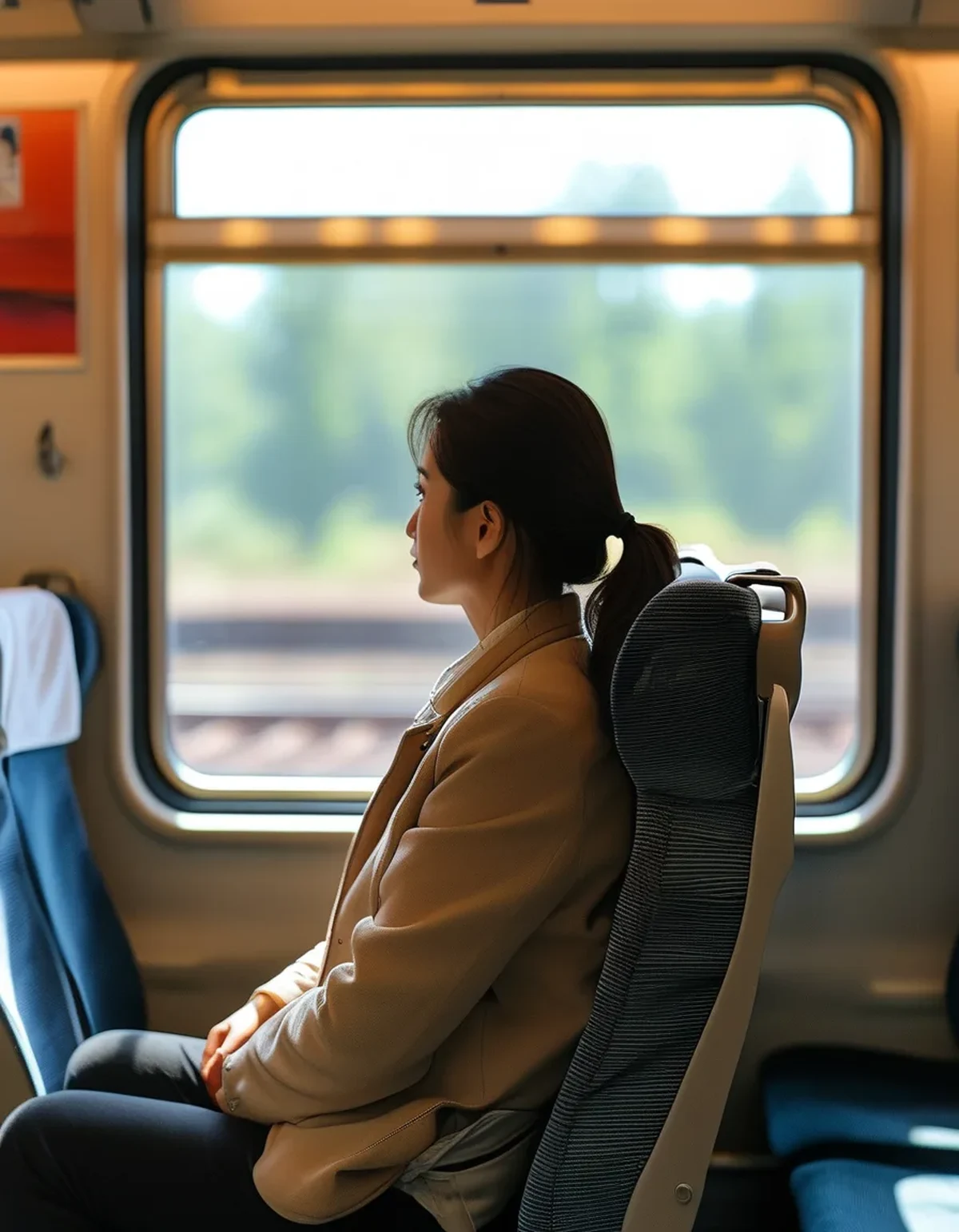
Trains are the most forgiving. Coaches are the least, for reasons that surprise people.
Trains have upright seats, more legroom, a corridor you can walk down, and — critically — a table on many services. That combination means you can change position genuinely often, which is most of the battle. The main train-specific risk is the laptop-on-the-table posture: a low screen pulls your head down and forward, and a two-hour work session on a train is as demanding on the neck as anything on a plane.
If you work on trains, raise the laptop on a bag and accept that the typing position will be imperfect. Head position matters more than wrist position over two hours.
Coaches combine the worst of the categories: reclined seats, limited legroom, sustained vibration, and no realistic way to walk around. On a long coach journey the only real lever you have is in-seat movement, and it is worth being deliberate about it.
A simple in-seat sequence, every 20 to 30 minutes:
- Roll both shoulders backwards five times
- Turn your head slowly to each side, holding briefly
- Press your low back gently into the seat, then release — five times
- Lift both heels, then both toes, ten times each
- Sit tall and take three slow breaths, letting your ribs move
It takes under two minutes and it works because it interrupts the sustained load. There is nothing magic about the specific movements; the interruption is the active ingredient.
What should you actually do during a long journey?
Plan the movement, not the posture.
Before you go:
- Pack a rolled scarf or small cushion for the low back. This is a two-minute preparation that outperforms every gadget
- If you are driving, set your seat before you leave rather than adjusting it at 70mph
- Wear something that lets you move. Rigid waistbands and stiff jeans genuinely restrict how much you shift position, and shifting position is the whole strategy
During:
- Every 20 to 30 minutes: change position. Cross the other leg, shift your weight, sit taller for a minute
- Every 60 to 90 minutes: stand and walk if you possibly can
- Any time you notice your head is forward: slide it back over your shoulders, hold five seconds, release. Do it ten times a journey and it becomes automatic
After:
- Walk for five minutes before you sit down again. The instinct after a long journey is to collapse into a chair, and that is the moment a stiff back becomes a sore one
- If something specific hurts, gentle movement in the opposite direction to how you were held usually helps — standing extension after hours of flexed sitting, for example
This is general information, not medical advice. Persistent pain after travel, pain that travels down a leg, or any numbness or weakness deserves a proper assessment from a physiotherapist or doctor rather than a stretch found online.
Myth vs Fact: Travel Posture
Myth: You should sit bolt upright for the whole journey
Fact: No one does, and holding any single position for hours is itself the problem. A moderately supported, slightly varied sitting position that you actually change every half hour beats a perfect position you abandon after fifteen minutes. Variety is the goal, not rigidity.
Myth: A big lumbar pillow is better than a small one
Fact: Size is not the variable — placement is. Support belongs low, at belt height, behind the pelvis. A large pillow that sits behind your ribcage tips your upper body forward and pushes your head out, trading a low back problem for a neck problem.
Myth: Neck pillows go behind your neck
Fact: The job of a travel neck support is to stop your head falling sideways or forwards while you sleep. That means bulk at the sides and front. Behind the neck, it does the opposite of what you want.
Myth: Reclining more is easier on your back
Fact: Up to a point, mild recline genuinely reduces disc pressure. Past roughly 110 degrees you start craning your head forward to see or read, and the neck pays for what the back saved.
Myth: Stiffness after a journey means you damaged something
Fact: Stiffness after prolonged sitting is overwhelmingly a normal response to being still, and it typically resolves within an hour of moving. Pain that persists for days, or that comes with numbness, is a different conversation.
FAQ: Travel Posture Questions, Answered
What is the single most useful thing to pack?
A rolled scarf, jumper, or small towel. Placed at belt height behind your pelvis, it fixes the most common problem in car, coach, and plane seats, costs nothing, and doubles as an actual scarf. Purpose-built lumbar rolls work too, but they are not meaningfully better.
I get neck pain only on flights, never in the car. Why?
Almost certainly the sleeping position. In a car you either drive or stay awake enough to correct yourself; on a plane you sleep with an unsupported head. Try a support that holds your head from the sides and see whether the pattern changes.
Are compression socks a posture thing?
Not directly, but they are related. They help with circulation and swelling on long journeys, and swollen, uncomfortable legs make you fidget and brace in ways that do affect your back. On flights over four hours they are a reasonable idea for most people.
How soon should I move after arriving?
Immediately, and for about five minutes. A short walk before you sit down again is the highest-value thing you can do at the end of a journey, and it is the thing almost nobody does.
Does a firmer or softer seat matter?
Less than duration does. A firm seat that you get out of every ninety minutes beats a plush one you sit in for five hours straight. If you can control only one variable, control the breaks.
TL;DR:
- Travel posture fails because of duration and constraint, not bad technique
- Cars load the low back through pelvic tilt; planes load the neck through head position; coaches add sustained vibration
- Support goes low, at belt height, behind the pelvis — never behind the ribs
- Change position every 20 to 30 minutes, and stand every 60 to 90 where you can
- Walk for five minutes on arrival before you sit down again
The single sentence worth remembering: on a long journey, movement beats posture. You will not hold a perfect position for five hours, and you do not need to. You need to stop holding any position long enough for it to become a problem — and that is a much easier thing to actually do.
This is general information, not medical advice. If travel consistently leaves you in pain, or you notice numbness, weakness, or pain radiating into a limb, see a physiotherapist or doctor for an individual assessment.
Keep Reading
This article is for general informational and styling purposes only. Fit, sizing, and product availability may vary.