How Do Your Shoes Change Your Posture From the Ground Up?
Quick Answer: Every shoe has a heel-to-toe drop, and that drop tilts your whole body forward by a small amount that your hips, spine, and neck then compensate for. A 10mm drop shifts you subtly onto your forefoot, which encourages a forward pelvic tilt, a deeper low-back curve, and a head that drifts forward to rebalance. This does not mean flat shoes are automatically better — it means changing shoe types abruptly is what causes trouble, and consistency matters more than the number.
You have fixed your chair. You have raised your monitor. You have done the stretches.
And by 3pm your shoulders are round again.
The thing nobody audited is sitting by the front door.
This is general information, not medical advice.

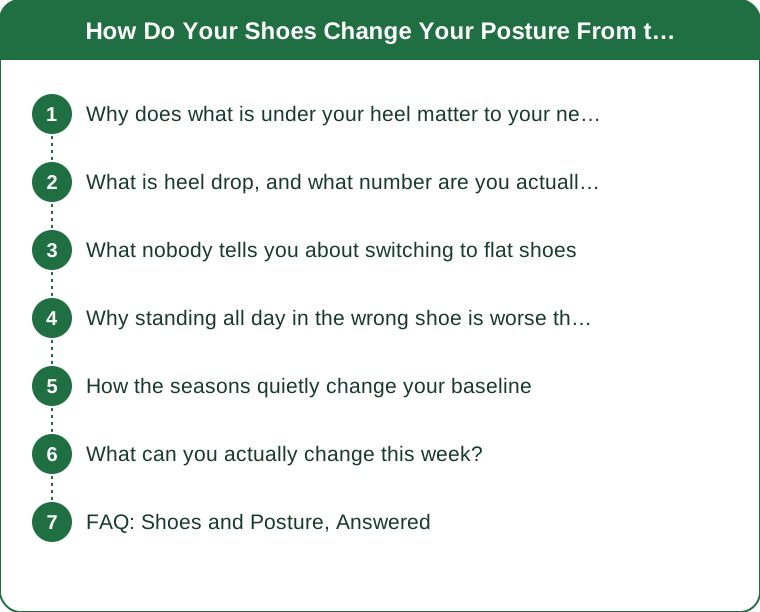
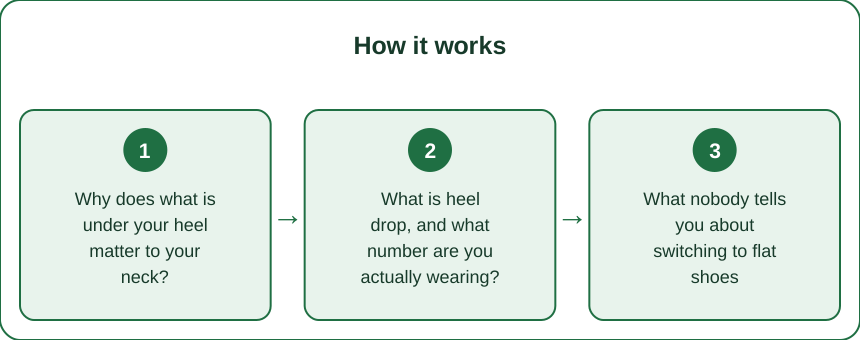
Why does what is under your heel matter to your neck?
Your body is a stack, and stacks are unforgiving about their base. If the bottom block tilts by two degrees, everything above it has to make that up somewhere — and the compensation does not stay local.
When you raise your heel above your forefoot, your center of mass moves forward. Your body will not accept that, because falling forward is not an option, so it corrects. The correction happens in a predictable sequence: your ankle dorsiflexes less, your knee softens slightly, your pelvis tips forward, your lumbar spine deepens its curve, your ribs flare, your upper back rounds to counterbalance the ribs, and your head slides forward to bring your eyes back to level.
That is six adjustments triggered by one change at the floor. Each one is small. Together they are the exact posture people describe as tech neck and blame entirely on their phone.
The phone is real. But if you spend nine hours a day in a shoe with a meaningful heel and then ten minutes a day correcting your neck, you are working against a much larger input with a much smaller tool. This is why posture corrections feel like they never stick — the correction is being applied at the top of a stack whose base has not moved.
The reverse also holds. Drop the heel and the whole sequence unwinds in the other direction: the pelvis levels, the lumbar curve softens, the ribs settle, and the head has less reason to drift. Which is why some people report their neck feeling different within a week of a footwear change they made for completely unrelated reasons.
What is heel drop, and what number are you actually wearing?
Heel drop is the height difference between where your heel sits and where your forefoot sits, measured in millimeters. It is not the same as cushioning, and it is not the same as how high the shoe looks.
Most people are wearing more drop than they would guess:
- Barefoot or minimalist shoes: 0mm. Your foot is level.
- Most everyday sneakers and lifestyle trainers: 8-12mm.
- Traditional running shoes: 10-12mm is still the most common category.
- Many boots and most dress shoes: 15-25mm, and often more than the visible heel suggests because the forefoot is also thin.
- A modest 2-inch heel: roughly 40-50mm of effective drop.
A 10mm drop does not sound like much until you realize it is present for every step you take, roughly seven thousand times a day, for years.
Here is the part that surprises people: the variety in your shoe rotation matters as much as any single number. If your week includes a 0mm trainer at the gym, a 12mm sneaker for errands, and a 40mm boot on weekends, your body is renegotiating its baseline three times a week and never fully settling into any of them. That instability shows up as posture that feels inconsistent — good on some days, collapsed on others, with no obvious cause.
Audit your actual rotation before you change anything. Line up every pair you wore in the last seven days and look at them from the side. Most people find a wider spread than they expected, and finding that spread is often more useful than picking a new pair.
What nobody tells you about switching to flat shoes
The advice to go flatter is everywhere, and the mechanics behind it are sound. What gets left out is that the transition is a genuine training load, not a purchase.
When you drop your heel height, your calf and Achilles suddenly have to work through a longer range than they have in years. If you have spent a decade at 10mm, your calf complex has adaptively shortened to fit. Going to 0mm overnight asks that tissue to lengthen immediately, under full body weight, for thousands of repetitions on day one.
The result is not usually dramatic. It is a dull calf ache, a tender Achilles in the morning, or arch soreness that shows up on day three and gets blamed on the shoes being bad. The shoes are not bad. The ramp was too fast.
A workable transition looks like this:
- Weeks 1-2: wear the flatter shoe for one to two hours a day, walking only, and keep your old shoes for anything long.
- Weeks 3-4: extend to half a day. Add calf raises — three sets of twelve, slow on the way down — every other day.
- Weeks 5-8: full days of walking. Still not running, still not long standing shifts.
- Beyond: add the demanding stuff back gradually.
Eight weeks feels absurdly slow for a shoe. It is the same timeline you would use for any other tissue adaptation, and footwear does not get an exemption just because it feels like shopping rather than training.
The people who report that minimalist shoes ruined their feet are, in the large majority of cases, describing a four-day transition. The people who report it changed their posture are describing a two-month one.

Why standing all day in the wrong shoe is worse than sitting in it
A shoe’s influence scales with how long you are loaded in it, and standing loads you continuously in a way sitting does not.
When you sit, your feet are largely unweighted. The heel drop still positions your ankle, but it is not driving your postural chain because your pelvis is being supported by a chair. This is why a desk worker can wear a fairly aggressive heel and mostly get away with it, and a retail worker in the same shoe cannot.
Standing is different in three ways. First, the load is constant. Second, standing posture has no external support, so every compensation in the chain is being held by muscle. Third — and this is the one that gets missed — standing still is harder than walking. Walking cycles the load between feet and through ranges. Standing still parks you at one angle and asks you to hold it.
So the highest-value footwear audit is not for the person at a desk. It is for anyone who stands in one place for more than three hours: teachers, nurses, hairdressers, retail staff, anyone at a standing desk they were told would fix their back.
For those situations, the specifics that matter are a moderate drop rather than an extreme in either direction, a wide enough toe box that your foot can spread and share the load, and a sole firm enough that your foot is not constantly making micro-corrections in soft foam. Very soft cushioning feels wonderful for the first hour and often feels worse by hour six, because your stabilizing muscles have been working nonstop against a surface that keeps moving.
A rotating pair helps more than a perfect pair. Two different shoes alternated across the week distribute the load across slightly different angles, which is easier on tissue than any single ideal choice.
How the seasons quietly change your baseline
This is the part people almost never connect, and it arrives on schedule every year around now.
Through summer you have probably been in sandals, flat slides, or thin canvas shoes — most of which sit near zero drop. Your body has spent three months at one baseline.
Then the mornings get cool, and the boots come out. Boots typically carry the most drop of anything in a wardrobe, often 20mm or more, and they are also stiff through the ankle, which removes some of the natural motion your foot had been using.
So in the space of about two weeks, your base tilts forward by more than it has all year, and your whole compensation chain reorganizes. The symptoms that follow are familiar and rarely attributed correctly: low back tightness in early autumn, calf cramps, a neck that feels worse than it did in July, and hip flexors that suddenly feel short.
Most people blame the weather, or sitting more indoors, or the return of a busier schedule. Some of that is real. But there is a mechanical change happening at the floor that is larger and more abrupt than anything else in the year.
The fix is simply to treat the seasonal switch as a transition rather than an event. Ease into boots over two weeks rather than one cold morning. Keep the flatter shoes in rotation rather than putting them away entirely. Add calf and ankle mobility work through late September and October, when the change is happening, rather than in January when you have already adapted and the window has closed.
The reverse transition in spring is gentler, because dropping from high to low is more forgiving than the other direction, but it is not free either.
What can you actually change this week?
Not everything here requires new shoes, and the free interventions are worth doing first.
Do the side-profile audit. Photograph every pair you wear regularly from the side, on a flat surface, at floor level. You will immediately see the spread in your rotation. Aim to narrow it — not to zero, but to a range rather than a scatter.
Reduce your worst-case exposure, not your average. If one pair is far more aggressive than the rest, capping its hours does more than optimizing everything else. Change out of the boots when you get home rather than wearing them until bed.
Add ankle range work, three minutes, daily. A knee-to-wall ankle mobilization and a slow calf raise off a step cover most of what shoe drop takes away. Three sets of ten each, done consistently, beats an elaborate program done twice.
Match the shoe to the day, not to the outfit. A day that involves six hours of standing has different requirements than a day of meetings. Most people choose footwear by what they are wearing and never by what they are doing.
Give any change eight weeks before judging it. Posture change from the ground up is slow because it is tissue adaptation, not a repositioning. If you evaluate at two weeks you will be evaluating the discomfort of the transition rather than the outcome.
And keep the correct expectation: footwear is one input among several. It will not undo nine hours at a badly set desk. But it is the input that is present every single step, and it is the one almost nobody has looked at.
FAQ: Shoes and Posture, Answered
Are zero-drop shoes better for posture?
Not automatically. They put your foot in a neutral position, which removes one compensation from the chain — but only if your calf and Achilles have adapted to handle it. A zero-drop shoe worn by an unprepared foot creates its own compensations. The best drop is the one you have transitioned into properly and can wear consistently.
Do orthotics help or hurt posture?
Properly prescribed orthotics address a specific structural issue and can genuinely improve how load travels up the chain. Generic over-the-counter inserts are a different proposition — they change your base without any assessment of whether that change is the one you needed. If you have pain, that is a professional’s question, not a shopping one.
How long before a shoe change shows up in my posture?
The positional change is immediate. The adaptive change — where your body stops compensating and settles into a new baseline — takes roughly six to twelve weeks. Most people quit somewhere around week three, which is the worst possible time because that is peak transition discomfort and zero accumulated benefit.
Should I wear the same drop for training and daily life?
Ideally they should be close, but they do not have to match. A large gap between your everyday shoe and your training shoe means every workout begins with a recalibration, which is not dangerous but does eat into the first part of your session. If you are dealing with persistent issues, narrowing that gap is worth trying.
Is a heel always bad?
No. A moderate heel can actually help people with limited ankle range perform certain movements, which is exactly why weightlifting shoes have one. The problem is not heel height. The problem is unexamined, inconsistent, all-day heel height in a body that has never been given a reason to adapt to it.
TL;DR:
- Heel drop tilts your base, and your pelvis, spine, and neck all compensate in a predictable chain — so posture work at the top fights an input at the bottom.
- Most everyday shoes sit at 8-12mm, boots and dress shoes often 20mm+, and a varied rotation means your body never settles at one baseline.
- Switching to flatter shoes is a tissue adaptation that needs roughly eight weeks, not a purchase you make on a Tuesday.
- Standing all day amplifies everything a shoe does; sitting mutes it.
- The autumn switch from summer flats to boots is the single largest, most abrupt base change of your year — ease into it over two weeks.
None of this replaces the desk setup, the movement breaks, or the strength work. It sits underneath them. If your posture corrections have been fading within twenty minutes for years, it is worth spending one evening looking at the row of shoes by your door before you buy another lumbar cushion. The stack starts at the floor, and that is usually the only part of it nobody has checked.
Keep Reading
This article is for general informational and styling purposes only. Fit, sizing, and product availability may vary.