Why Standing on One Leg Quietly Reshapes Your Posture
Quick Answer: Habitual one-leg standing — the hip-out, weight-shifted stance — loads one side of the pelvis for hours a day. Over months this produces asymmetric hip and trunk muscle tone, a subtly tilted pelvis, and one-sided low back or hip discomfort that stretching does not resolve. The fix is not to stop standing asymmetrically; it is to notice it, alternate it, and build the specific stability the habit is compensating for.
Everyone talks about sitting.
Almost nobody talks about the two to four hours a day you spend standing still — at a counter, in a queue, at a bus stop, on a call — and what your body does during those hours.
Watch yourself the next time you are washing up. There is a good chance one hip is pushed out to the side, most of your weight is on one leg, and you have been in that exact position for six minutes without registering it. And there is a very good chance it is the same side every time.

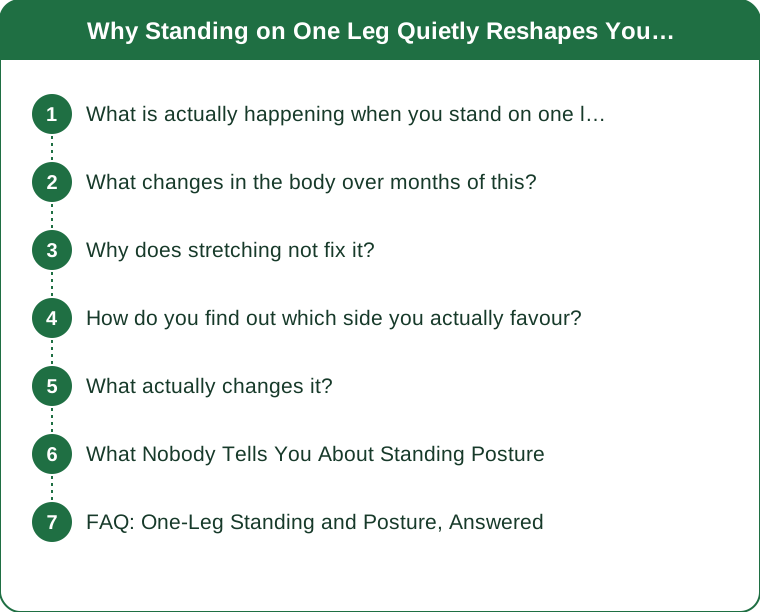
What is actually happening when you stand on one leg?
It is a genuinely clever piece of energy saving, and that is why it becomes a habit.
Standing evenly on two legs requires continuous low-level muscular work from the hip abductors, the deep hip rotators and the trunk. It is not much, but it is constant.
When you shift onto one leg and push the hip out laterally, you hang on passive structures instead. Weight goes over the standing leg, the pelvis drops on the unloaded side, and the body rests on the iliotibial band, the hip joint capsule and the ligaments of the standing side. Muscular effort drops toward zero.
Your nervous system likes this. It is cheaper. So it repeats it, and because most people have a dominant side, it repeats it on the same leg.
A few numbers make the scale clear. If you stand still for two hours a day and spend three quarters of that time on one leg, that is roughly 550 hours a year of asymmetric loading through one hip. No stretching routine competes with 550 hours of anything.
The individual instance is harmless. It is the accumulated repetition, always on one side, that does the shaping. This is the same logic as always carrying a bag on one shoulder, but it runs for far more hours a day and almost nobody notices it happening.
What changes in the body over months of this?
The changes are gradual, structural in feel, and they cluster on predictable sides.
On the standing (loaded) side, the hip abductors — mainly gluteus medius — become long and quiet. They are not being asked to hold the pelvis level because the joint capsule and the IT band are doing it. Meanwhile the adductors on that side shorten slightly.
On the unloaded side, the quadratus lumborum and lateral trunk muscles take on the job of holding the pelvis up. They become chronically short and tight, which is why one-sided low back tightness is one of the classic signatures.
Through the spine, the pelvis tilts laterally and the lumbar spine curves gently to compensate, then the thoracic spine curves back the other way to keep your eyes level. Your body will always prioritise a level horizon, and it will bend the spine to get one.
At the standing hip joint itself, load distribution changes. The hip is designed for load — but for load shared through a moving joint, not concentrated in one position for extended periods.
None of this appears overnight. The typical story is a person in their thirties or forties noticing one-sided hip or low back discomfort with no injury behind it, who has been standing this way since school.
Why does stretching not fix it?
Because you are stretching the muscle that is doing the work, not the one that quit.
The tight side feels tight because it is holding you up. Stretch it and you get 20 minutes of relief, then it tightens again by lunchtime — because the underlying job has not gone anywhere.
This is one of the most common frustrations in posture work. Tightness is usually a symptom of instability somewhere else in the chain. The quadratus lumborum on the unloaded side is short because the gluteus medius on the loaded side is not holding the pelvis level. Lengthen the QL without addressing the glute and the body simply recreates the tension, often within hours.
There is a second reason stretching underperforms here: the position is habitual, not structural. You are not restricted from standing evenly — you can do it right now. You just do not, because it costs more energy and nothing is prompting you to.
Habits respond to cues and repetition. They do not respond to a 30-second hamstring stretch at the end of a workout.
The productive sequence is: notice the habit → interrupt it → build the missing stability → let the tightness resolve on its own. In that order. Almost everyone tries it backwards.

How do you find out which side you actually favour?
Self-report is unreliable here. Most people guess wrong. Use evidence instead.
The shoe wear test. Look at the outsoles of a well-worn pair. Uneven wear patterns between left and right are a reasonable clue about how you load.
The photo test. Have someone photograph you from behind, standing normally, while you are distracted — mid-conversation is ideal, because as soon as you know you are being photographed you will stand evenly. Look at whether the two dimples at the base of your spine sit level.
The trouser test. If hems consistently sit differently on one side, or a skirt rotates one way through the day, a lateral pelvic tilt is a common cause.
The counter test. Set a timer for a random moment during the day. When it goes, freeze and observe where your weight is without correcting first. Do this five times over two days and the pattern is usually unmistakable.
The queue test. Notice which foot you step forward with when you shift weight while waiting. It is almost always the same one.
Two or three of these agreeing is enough. You do not need a formal assessment to act on this — you need to know which side to start with.
What actually changes it?
Three layers, run together for six to eight weeks.
Layer one: interrupt the habit. Pick two locations where you reliably stand still — the kitchen sink and wherever you make phone calls work well. Every time you find yourself there, stand evenly with feet hip-width, weight through both heels. You will drift back within a minute at first. That is fine. The point is the noticing, not the holding.
A useful bridge: rather than forcing perfect even stance, deliberately alternate sides. Stand on your non-dominant leg for the second half of every wait. Alternating is far easier to sustain than symmetry, and it removes most of the accumulated one-sidedness.
Layer two: build the hip stability that is missing. Three exercises, three times a week, about 12 minutes:
- Side-lying hip abduction — 3 sets of 12 each side, slow, with the top leg slightly behind the body. Most people cheat this by rolling backward; keep the hips stacked.
- Single-leg stance holds — 3 sets of 30 seconds each side, aiming for a level pelvis rather than a long hold. Progress by closing your eyes, not by adding time.
- Suitcase carries — 3 sets of 30 seconds each side with a moderate weight in one hand, ribs down, trying not to lean. This trains the exact resistance to lateral collapse the habit erodes.
Layer three: release only after loading. Do lateral trunk and hip flexor work at the end of a session, once the stability work is done. Release before loading, and you have simply made the compensating muscle less able to compensate.
Expect the first noticeable change in three to four weeks, and expect it to show up as less end-of-day one-sided ache rather than as a dramatic postural transformation.
What Nobody Tells You About Standing Posture
Standing perfectly still is not the goal. Prolonged symmetrical standing is also fatiguing and is its own risk factor for low back discomfort. The healthy pattern is frequent small shifts, not statue-like stillness. Movement variety beats any single ideal position.
Your standing habit follows you into training. People who load one hip standing tend to shift toward the same side in squats and deadlifts. Fixing the standing habit sometimes resolves a lifting asymmetry that no amount of cueing at the bar would touch.
Holding a child sets the pattern hard. Carrying a toddler on one hip is one-leg standing with added load, repeated hundreds of times. Parents who develop one-sided hip issues in their thirties are often living out this exact mechanism. Alternate sides deliberately — it feels wrong at first, and that wrongness is the point.
Footwear changes how much you drift. A shoe with a soft, unstable sole increases the effort of even standing, which makes shifting to one leg more tempting. Firmer, flatter soles help slightly.
The season matters more than you would guess. As autumn arrives you stand still outdoors more — waiting for buses in the cold, standing at touchlines — and cold, tense standing amplifies the shift. Late September is when a lot of people first notice one-sided hip ache.
FAQ: One-Leg Standing and Posture, Answered
Is standing on one leg bad for you?
No. Doing it occasionally is completely normal and useful — it is how you rest while upright. The problem is doing it on the same side for the majority of your standing hours across years. Frequency and one-sidedness are what matter, not the position itself.
Can this cause a real leg-length difference?
It cannot change bone length, but it can produce a functional leg-length difference, where a tilted pelvis makes one leg behave as though it were longer. That functional difference is usually reversible with the stability work above. A true structural difference is a separate matter and worth assessing properly.
How long until my hips look level again?
Visible change is slow and unreliable as a measure. Aim for six to eight weeks for symptoms and function, and treat appearance as a lagging indicator. Many people end up perfectly comfortable with hips that still photograph slightly unevenly, which is a completely acceptable outcome.
Does a standing desk make this better or worse?
Both, depending on how you use it. It increases total standing hours, which amplifies whatever pattern you have. Standing desks pair well with a footrest bar you can alternate feet on — that gives you a structured way to shift sides instead of defaulting to one.
This is general information, not medical advice. One-sided hip, groin or low back pain that is worsening, wakes you at night, or comes with numbness or weakness should be assessed by a physiotherapist or doctor.
TL;DR:
- Habitual one-leg standing is an energy-saving strategy that hangs your body on passive tissue instead of muscle — and most people do it on the same side every time.
- Roughly 550 hours a year of asymmetric load produces a quiet lateral pelvic tilt, a long quiet glute on one side and a short tight trunk on the other.
- Stretching the tight side fails because tightness is the symptom, not the cause; the missing piece is hip stability on the loaded side.
- Fix it in three layers: notice and alternate the habit, build abduction and anti-lateral-flexion strength three times a week, and release only after loading.
- Expect meaningful change in six to eight weeks, judged by end-of-day comfort rather than by how level you look in a photo.
You cannot out-stretch a habit that runs for two hours a day. But you can notice it, share the load between both sides, and give your hips a reason to hold you up again — and that combination does work.
Keep Reading
This article is for general informational and styling purposes only. Fit, sizing, and product availability may vary.