Why Getting Stronger Can Make Your Posture Worse, Not Better
Quick Answer: Most training programs develop the front of the body more than the back, and most daily life already does the same. Strength adds resting tone to whatever you train, so a chest and shoulder-heavy program layered on top of a desk-based day pulls the shoulders forward more, not less. Posture is not a strength problem or a stretching problem, it is a balance problem between opposing muscle groups and how much of the day you spend in one position. The fix is a pulling-to-pushing ratio of at least 2 to 1 plus positional variety, not more posture exercises.
It is a genuinely disorienting outcome. You did the work, the numbers went up, and the thing you wanted to change went the wrong way.
This blog has covered why your posture collapses when you concentrate, why your shoulders round by 3pm, and why posture fixes keep not sticking. This one is the structural version of the same problem, and it is the one that takes the longest to notice.

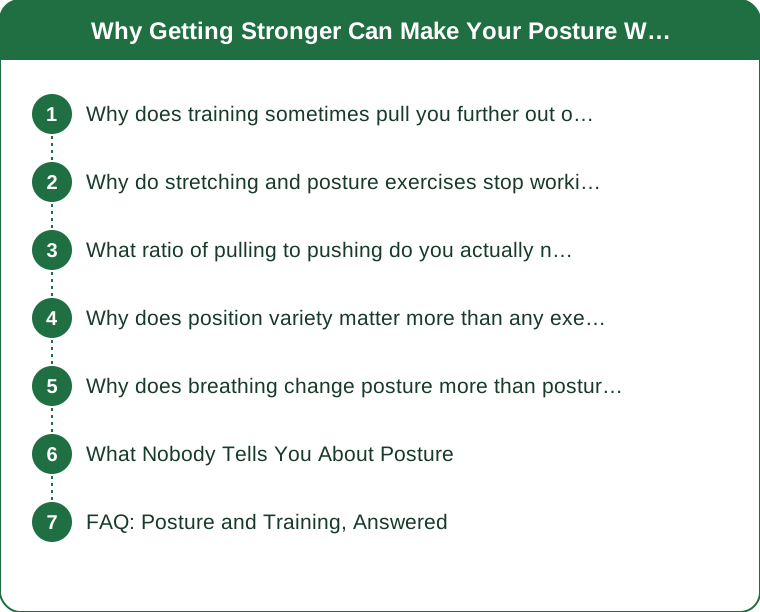
Why does training sometimes pull you further out of alignment?
Because strength training increases resting muscle tone, and it does so on whatever you actually train.
Muscles do not only pull when you tell them to. A trained muscle carries more resting tension than an untrained one. This is a normal adaptation and it means the balance of tension across a joint shifts toward whatever you have been strengthening.
Most popular programs are front-loaded. Bench press, push-ups, overhead press, dips, and most machine chest work all develop the front of the shoulder girdle. The corresponding back work often amounts to one row variation, done last, with less attention and lighter effort.
Your day is already front-loaded before you train. Typing, driving, holding a phone, cooking, and carrying all happen in front of your body with your arms internally rotated. Nothing in a normal day asks the muscles between your shoulder blades to work.
So the training adds to an existing imbalance rather than correcting it. A program that would produce balanced posture in someone who spent their day working with their arms overhead produces rounded shoulders in someone who spends it at a keyboard.
Lat development contributes in a way people do not expect. Strong, well-developed lats pull the shoulders down and forward into internal rotation. Heavy pull-down and pull-up work without matching mid-back and external rotation work is a common and completely invisible cause of worsening shoulder position in people who train seriously.
And hip work feeds into it from below. Heavy squatting and deadlifting with tight hip flexors and limited mobility often produces a subtle increase in lower back arch, which tips the ribcage and changes shoulder position at the top of the chain. Posture is one connected system and the shoulders are frequently reporting a problem that starts at the pelvis.
Why do stretching and posture exercises stop working?
Because they address sensation rather than the balance of forces, and they occupy a tiny fraction of your day.
Stretching a tight muscle changes tolerance more than length. Most of the immediate improvement from a stretch is a change in how much stretch your nervous system will permit, not a lasting structural change. It feels excellent and it fades within hours.
Ten minutes cannot outvote ten hours. A daily posture routine is roughly one percent of your waking day. The other 99 percent is where your body decides what its default position should be.
Tight muscles are frequently the ones being overworked, not the ones that need stretching. The muscles between your shoulder blades often feel tight precisely because they are lengthened and straining to hold a load they are too weak for. Stretching them makes them feel briefly better and does nothing about the cause.
Corrective exercises done without load rarely transfer. Band pull-aparts done casually while distracted create very little adaptation. The same movement done with genuine effort and progressive load is one of the most effective things available.
And posture cues create temporary compliance rather than change. Pulling your shoulders back when reminded works while you are thinking about it. This is why posture collapses the moment you concentrate on anything else, which is a topic this blog has covered in its own right.
The distinction that matters is between what you can do and what you default to. Almost everyone can achieve good posture when asked. Posture is about the position you occupy when you are not asked, and that is set by strength balance and positional habit, neither of which respond to reminders.
What ratio of pulling to pushing do you actually need?
At least two pulling movements for every pushing movement, and more if you have a desk-based job.
Count sets across the week, not exercises within a session. If you bench twice a week for four sets each, that is eight pushing sets, and you need at least sixteen pulling sets to balance it.
Distinguish between vertical and horizontal pulling. Pull-ups and lat pull-downs are vertical and develop the lats, which contribute to internal rotation. Rows are horizontal and develop the mid-back muscles that hold your shoulder blades back. For posture specifically, horizontal pulling is the more valuable of the two.
Include dedicated external rotation work. Face pulls, band external rotations, and prone Y and T raises target small muscles that no compound lift trains sufficiently. Two or three sets, twice a week, with light load and full range.
Train the deep neck flexors, which almost nobody does. Chin tucks against light resistance address forward head position directly. This is the piece most likely to be missing from an otherwise sensible program.
Do the pulling work first in the session, not last. Whatever comes first gets your best effort and attention. If posture is a goal, rows deserve the position that bench press currently occupies.
And progress the pulling work like you progress everything else. Rows done with the same weight for a year produce a year of no adaptation. The mid-back responds to progressive overload exactly like every other muscle group, and most people never load it hard enough to find out.

Why does position variety matter more than any exercise?
Because your body adapts to the position it spends the most time in, and that is almost never the gym.
Tissues remodel toward habitual position over months. Muscles held short adapt to being short, and connective tissue reorganises around the shapes it most often occupies. Eight hours a day in one position is a powerful, continuous signal.
No single sitting position is correct. The best posture is genuinely the next one. A perfectly set-up ergonomic chair held for four hours is worse than an imperfect setup you move in every twenty minutes.
Set a movement interval rather than a posture target. Standing up every 30 minutes, even for 30 seconds, does more for how your back and shoulders feel at 4pm than any amount of concentrating on sitting up straight.
Change the height of things. Alternating between sitting and standing, or between a desk and a higher counter, forces different joint angles and different muscles into the supporting role. Variety is the mechanism, not any particular height.
Watch the phone specifically. Looking down at a phone places substantial extra load on the neck, and the average person now spends hours a day doing it. Raising the phone toward eye level is one of the few posture changes that is both trivially easy and genuinely significant.
And carry things differently. A bag on the same shoulder every day, a child on the same hip, or a laptop under the same arm all create asymmetric loading that no symmetrical training program will notice or correct. Alternate sides deliberately.
The overall principle is that posture is an average, not a position. You cannot hold a good position all day and you do not need to. You need the average across the day to be varied enough that no single shape becomes the default.
Why does breathing change posture more than posture changes breathing?
Because your ribcage position is set largely by how you breathe, and everything above it follows.
Chest breathing raises and holds the ribcage. Breathing predominantly through the upper chest keeps the ribs slightly elevated and flared, which tips the whole shoulder girdle and increases the arch in your lower back. Held for years, this becomes structural.
Diaphragmatic breathing lets the ribcage sit down and back. Breathing into the lower ribs and belly allows a rib position from which the shoulders can sit naturally, without any effort to pull them back.
Stress reinforces the wrong pattern. Under stress, breathing becomes shallow and upper-chest dominant, and the shoulders elevate. A stressful workday is a several-hour training session in the exact posture you are trying to avoid.
Neck muscles get recruited as accessory breathing muscles. The scalenes and upper trapezius help lift the ribcage during shallow breathing. Doing this thousands of times a day is a large part of why those muscles feel permanently tight and why massaging them provides only temporary relief.
A simple check takes ten seconds. Place one hand on your chest and one on your belly and breathe normally without changing anything. If the upper hand moves substantially more, that is the pattern running all day.
Retraining it is genuinely slow and worth it. A few minutes daily of lying on your back, knees bent, breathing so the lower hand rises and the upper stays still, gradually shifts the default. The measure of progress is what happens when you are not paying attention, which takes weeks to change and then stays changed.
What Nobody Tells You About Posture
There is no single correct posture, and the research on posture and pain is much weaker than the internet suggests. Plenty of people with visibly imperfect posture have no pain at all, and the strongest predictor of discomfort is how long you hold any position rather than which position it is.
Posture photographs are misleading. A side-on photo captures one instant of a system that shifts constantly. Most people photograph themselves at the end of a long day and compare it to someone else photographed at the start of one.
Feeling straight and being straight are different things. After years in one position, correct alignment genuinely feels wrong and exaggerated. Early in the process, trust a mirror or a photo rather than the sensation.
Progress shows up in endurance before appearance. The first real sign of improvement is that your posture holds until 5pm instead of collapsing at 2pm. Visible change comes considerably later.
Sleeping position contributes and is rarely mentioned. Seven or eight hours in one shape is a third of your life, and stomach sleeping in particular holds the neck rotated for the entire night.
And the timeline is longer than anyone tells you. Meaningful change in habitual posture takes three to six months of consistent strength work and positional variety. Anything promising results in two weeks is describing the temporary tolerance change from stretching, which is real and does not last.
One more thing worth knowing: if you have pain that is sharp, radiating, involves numbness or tingling, or wakes you at night, that is not a posture problem to solve with exercises. This is general information, not medical advice, and that pattern is worth a professional assessment.
FAQ: Posture and Training, Answered
Can lifting weights make my posture worse?
Yes, if the program is push-dominant and your day is already spent with your arms in front of you. Strength adds resting tone to what you train, so training the front more than the back deepens an existing imbalance.
How many rows should I do compared to pressing?
At least two pulling sets for every pushing set across the week, weighted toward horizontal rowing rather than vertical pulling. Add dedicated external rotation and chin tuck work, which no compound lift covers.
Why does my posture look fine in the morning and bad by the afternoon?
Endurance, not alignment. The muscles holding your position fatigue over hours. This is why the first sign of genuine improvement is that good posture lasts later into the day rather than looking different at 9am.
How long does it take to change posture?
Three to six months of consistent strength balance and positional variety for a habitual change. The immediate improvement from stretching is a temporary change in stretch tolerance and it fades within hours.
TL;DR:
- Strength adds resting tone to whatever you train, so a push-heavy program on top of a desk-based day worsens shoulder position.
- Posture is a balance problem between opposing muscles plus how long you hold one position, not a stretching problem.
- Aim for at least 2 pulling sets per pushing set, favour horizontal rows, and add external rotation and chin tuck work.
- Positional variety through the day and diaphragmatic breathing change your default more than any exercise routine does.
- Expect three to six months, and expect the first improvement to be endurance rather than appearance.
Stop counting the ten minutes of posture exercises and start counting the ten hours. That is where your default position is actually decided.
Keep Reading
This article is for general informational and styling purposes only. Fit, sizing, and product availability may vary.