What Stress Actually Does to Your Posture — The Complete Guide
Quick Answer: Stress shortens your breathing into the upper chest, which recruits the neck and shoulder muscles as accessory breathing muscles roughly 12 to 20 times a minute. Within an hour that produces the exact posture you associate with tension — elevated shoulders, forward head, stiff ribs — and no amount of sitting up straight fixes it while the breathing pattern remains.
You did not decide to raise your shoulders. Nobody does.
But by three in the afternoon they are an inch higher than they were at nine, and the deadline is the only thing that changed.

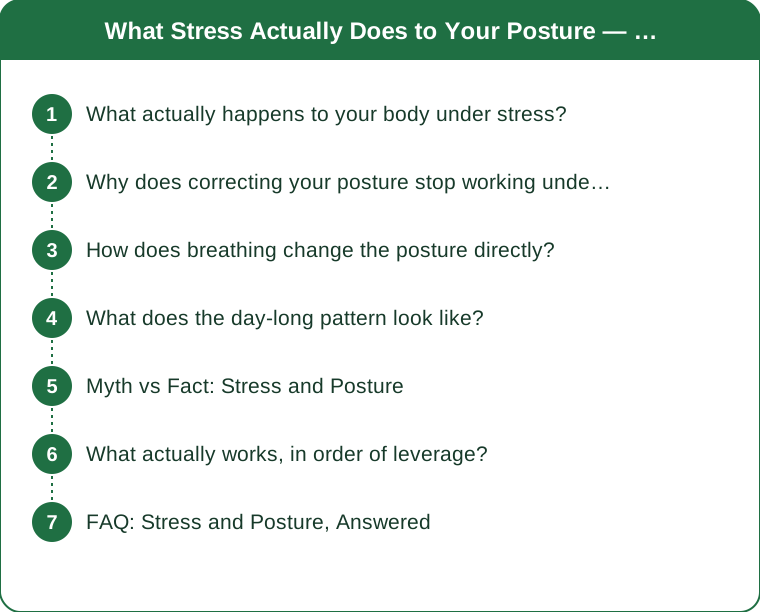
What actually happens to your body under stress?
The posture change is a byproduct of a breathing change, and the breathing change comes first.
Stress shifts breathing from the diaphragm to the upper chest. Under a perceived threat — deadline, difficult email, traffic — the sympathetic nervous system prepares for rapid action. Part of that preparation is faster, shallower breathing that draws primarily from the upper chest rather than the belly.
Upper chest breathing recruits neck and shoulder muscles. The scalenes, sternocleidomastoid, and upper trapezius are accessory breathing muscles. They are designed to help during hard exercise, in short bursts. Under stress breathing, they work continuously.
The math is what makes it significant. At 16 breaths per minute, those muscles contract nearly a thousand times an hour. No muscle in the body is designed to work at that duty cycle without changing its resting length, and shortened resting length is what we perceive as tight shoulders.
Muscle tone rises globally. Sympathetic activation increases baseline tension across the body, including in muscles doing nothing useful. Jaw, forearms, and the small muscles at the base of the skull are the common sites, and all three feed into head position.
Visual focus narrows and pulls the head forward. Concentration on a screen or a problem draws the head toward the object of attention. Every inch of forward head position adds roughly 10 pounds of effective load on the neck extensors, which then have to work harder, which produces more tension.
Blood flow redistributes. Sympathetic activation prioritizes large muscle groups and reduces flow to the smaller postural stabilizers. Those muscles fatigue earlier than they otherwise would, so your ability to hold a position degrades faster on a stressful day than on a calm one at identical desk time.
The sequence runs breathing, tension, position, awareness — in that order. You become aware of it last, typically hours after it started, which is why it feels like it appeared out of nowhere.
Why does correcting your posture stop working under stress?
Because you are fighting a continuously running process with an intermittent intervention.
The correction addresses position; the stress addresses the driver. Pulling your shoulders down is a voluntary muscular act that lasts as long as your attention does. The breathing pattern producing the elevation continues regardless, so within a minute or two of your attention moving on, the shoulders return.
Voluntary correction adds tension rather than removing it. Holding a corrected position means contracting one set of muscles against another. The net muscular activity in your upper back goes up, not down, which is why an afternoon of good posture reminders can leave you more sore than a slouched one.
Attention is the scarce resource under stress, and it is already spent. The state that causes the postural change is the same state that eliminates your spare capacity to monitor for it. This is the core reason posture cues fail on exactly the days you need them.
The proprioceptive baseline drifts. After an hour in a position, your sense of neutral recalibrates around it. The corrected position begins to feel wrong and the stressed position feels normal — which means you cannot rely on feel to tell you where you are.
Reminders create a stress of their own. An app buzzing every twenty minutes about your posture adds one more demand to a day already full of them. Plenty of people abandon posture interventions not because they do not work but because they became another source of low-grade pressure.
The correction targets the wrong end of the chain. If shortened breathing is the input and shoulder elevation is the output, working on the output is permanent maintenance. Working on the input is a fix.
How does breathing change the posture directly?
The diaphragm is a postural muscle as much as a respiratory one, and this is where the leverage is.
The diaphragm attaches to the lumbar spine and the lower ribs. When it works well, it stabilizes the trunk from the inside while it breathes. When it is underused, that stabilizing role is handed to superficial muscles that are worse at it and get tired.
Diaphragmatic breathing expands the lower ribs sideways. Place your hands on your lower ribs; a good breath widens them laterally rather than lifting your chest upward. Most people under stress get almost no lateral movement, and the difference is easy to feel.
Rib position sets shoulder blade position. The shoulder blades slide on the ribcage. If the ribcage is held in a permanently inhaled position — chest up, lower ribs flared — the blades cannot sit flat, and everything above them compensates.
Slower breathing reduces sympathetic drive. Extending the exhale relative to the inhale — say, in for 4 and out for 6 — measurably increases parasympathetic activity within a couple of minutes. This is not a relaxation platitude; it is a specific, testable physiological lever, and it works whether or not the stressor has gone away.
Exhaling fully is the part people skip. Under stress, breathing becomes top-heavy: repeated partial inhales onto an already partly full chest. Emptying properly is what lets the ribcage drop back to a neutral position, and it is the single most useful thing to practice.
Two minutes is enough to shift the pattern. You are not trying to relax; you are trying to reset the ribcage. Ten slow breaths with a long exhale will drop the shoulders further than five minutes of stretching, because it addresses the reason they were up.
The effect on posture is immediate and the effect on habit is slow. One session changes the next twenty minutes. Repeated sessions over a few weeks change the resting pattern, which is the actual goal.

What does the day-long pattern look like?
Recognizing the timeline makes the intervention points obvious.
Morning is usually your best posture of the day. A night of lying down restores muscle length and no stressors have accumulated. This is why posture at 9am tells you very little about your posture problem.
The first significant drift happens 60 to 90 minutes into focused work. Not from fatigue — from concentration. The head moves toward the screen and the breathing shortens as attention narrows.
Mid-morning stress events compound rather than reset. Each demanding interaction adds tension, and there is rarely enough recovery time between them for the baseline to return. The stress does not have to be dramatic; a sequence of small ones works the same way.
The 2 to 4pm window is where most people report the worst of it. Cumulative tension, lower alertness, and the largest gap since the last real break. This is when shoulder height, forward head position, and jaw tension all peak together.
Evening tension persists even after the work stops. The muscular pattern outlasts the stressor by hours, which is why people who feel fine after logging off still have a stiff neck at 9pm. The nervous system’s return to baseline takes far longer than the meeting did.
Sleep resets length but not habit. You wake with the shortening undone and the breathing pattern intact, ready to reproduce it. That is why this loops daily and why interventions have to be daily too.
Weekly accumulation is real. Thursday’s baseline is typically worse than Monday’s for the same reason a Thursday workout feels heavier. Where a week lands matters as much as where a day does.
Myth vs Fact: Stress and Posture
Myth: Tight shoulders mean you need to stretch more. Fact: A muscle held short by continuous low-level contraction does not stay lengthened after stretching, because the contraction resumes the moment you stop. Stretching feels good and lasts about as long as the stretch. Changing the breathing pattern is what changes the resting tone.
Myth: Better ergonomics solves stress-related posture. Fact: A good chair removes one contributor and leaves the driver untouched. People with excellent workstations still develop the same pattern under deadline pressure, because a chair cannot change how you breathe.
Myth: Strong upper back muscles prevent it. Fact: Strength helps the position you can hold when you are thinking about it. Under stress the problem is not capacity but continuous involuntary activation of the opposing muscles. Strong people get stress posture too — sometimes more visibly, because they hold more tension.
Myth: You should be able to feel it happening. Fact: Proprioceptive drift means the developing position feels normal while it is developing. The first reliable signals are usually indirect — a tight jaw, a headache at the base of the skull, or noticing that a deep breath feels unusually satisfying.
Myth: The fix takes a long time. Fact: The acute fix takes about two minutes and works every time you use it. The habit change takes a few weeks. People conflate the two and give up during a wait that was never necessary.
Myth: It only affects people with desk jobs. Fact: The mechanism is breathing, not sitting. Nurses, teachers, and parents of small children all show the same pattern while on their feet all day, and are often more surprised by it because the usual explanation does not apply.
What actually works, in order of leverage?
Ranked by how much change you get per minute spent.
1. Extended-exhale breathing, two minutes, three times a day. In through the nose for a count of 4, out for 6 to 8, with a focus on emptying completely. This is the highest-return intervention available and it requires no equipment or privacy. Set it against events you already have — after a meeting, before lunch, at the end of a call.
2. Lateral rib expansion practice, one minute. Hands on your lower ribs, breathe so your hands move outward rather than your chest moving up. This retrains the movement pattern rather than just slowing the rate, and it is the piece most people skip.
3. A genuine position change every 45 minutes. Not a stretch — a change. Stand, walk to another room, look at something 20 feet away. It resets both the proprioceptive baseline and the visual focus that pulls the head forward.
4. Thoracic rotation, five each side. Seated, hands behind your head, rotate slowly. The ribcage stiffens under stress breathing, and rotation restores the mobility that lets the shoulder blades sit properly.
5. Jaw and tongue release. Let the teeth part slightly and rest the tongue on the roof of the mouth. Jaw tension and neck tension are closely linked, and this is a two-second intervention you can do mid-conversation.
6. Strength work, twice a week. Rows, face pulls, and carries build the capacity that makes a neutral position sustainable. This is genuinely useful and it is sixth on the list, not first — it supports the fix rather than being it.
7. Address the actual stressor where you can. The most reliable posture intervention is a lighter Thursday. That is not always available, but it belongs on the list honestly, because everything above it manages a symptom.
If you have persistent numbness or tingling down an arm, headaches that are worsening or different from usual, or pain that wakes you at night, those are reasons to see a clinician rather than to breathe differently. This is general information, not medical advice.
FAQ: Stress and Posture, Answered
How quickly does stress actually change my posture?
Measurably within 10 to 20 minutes of sustained stress breathing, and obviously within an hour. The shoulders elevate first, the head drifts forward second, and rib mobility drops throughout. Most people notice it four to six hours in, when the tension becomes uncomfortable rather than when it begins.
Why does a deep breath feel so good when I am tense?
Because your ribcage has been moving through a fraction of its normal range for hours and your diaphragm has been underused. The satisfaction is the sensation of the lower ribs actually expanding again. It is also a useful signal — if a deep breath feels unusually good, the pattern has been running for a while.
Can I fix stress posture without reducing my stress?
Partly, and more than you would expect. Breathing interventions work on the physiological mechanism regardless of whether the stressor resolves, so the postural consequences are genuinely reducible. The underlying load is worth addressing on its own merits, but you are not stuck waiting for a calmer month.
Does this explain why my posture is worse on some days than others?
Largely, yes. Desk time is fairly constant week to week while stress is not, and stress is the variable that moves. If you have wondered why the same chair and the same hours produce very different neck stiffness on different days, this is usually the reason.
TL;DR:
- Stress shifts breathing to the upper chest, which recruits neck and shoulder muscles roughly a thousand times an hour.
- Posture correction fails under stress because it treats the output while the breathing pattern driving it keeps running.
- Two minutes of extended-exhale breathing drops the shoulders further than stretching, because it addresses the cause.
- The daily peak lands between 2 and 4pm, and tension outlasts the stressor by hours — which is why evening stiffness follows a day that felt fine.
- Strength work helps and belongs sixth on the list, not first.
The shoulders that crept up all afternoon were never a discipline problem. They were doing a breathing job nobody assigned them, and the fastest way to give them that job back is to breathe out properly for two minutes.
Keep Reading
This article is for general informational and styling purposes only. Fit, sizing, and product availability may vary.