Why Standing Desk Posture Quietly Gets Worse the Longer You Stand
Quick Answer: Standing itself doesn’t automatically produce good posture — it removes the chair’s passive support and asks postural muscles (core, glutes, upper back) to actively hold alignment for extended periods, and as those muscles fatigue over the course of a long standing session, the body defaults to leaning on ligaments and joints instead, which shows up as a slow slouch, hip shift, or locked knees rather than a sudden collapse.
A standing desk swaps one posture problem for a different, more gradual one — and without active postural endurance training, that slow fatigue-driven slouch creeps in almost every time.

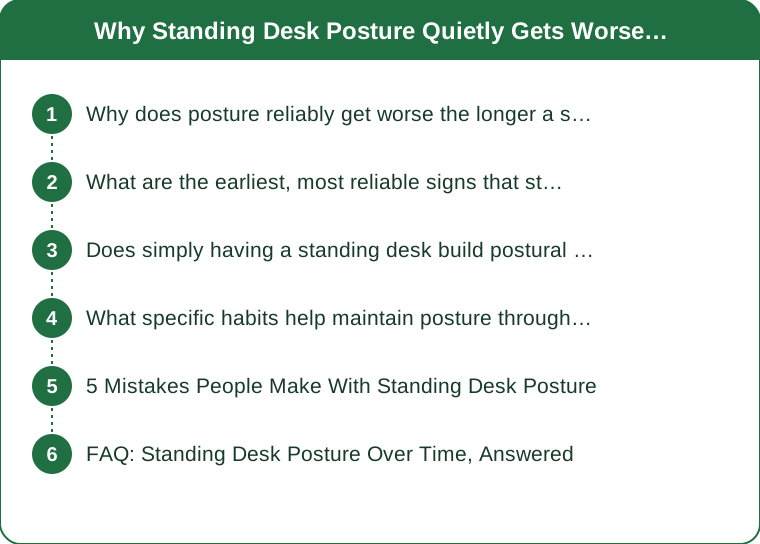
Why does posture reliably get worse the longer a standing session lasts, rather than staying consistent?
Standing upright with good alignment requires sustained, low-level activation from the core, glutes, and upper back muscles, and like any sustained muscular effort, this activation fatigues over time. As these muscles tire, the body unconsciously shifts toward passive structures — locking the knees, shifting weight onto one hip, or letting the shoulders round forward — because it’s less immediately effortful, even though it produces worse alignment and more joint strain over a full session.
What are the earliest, most reliable signs that standing posture is starting to fatigue?
A shift to standing more heavily on one leg, a slight forward head lean toward the screen, or knees locking into hyperextension are usually the first signals, often appearing well before any conscious feeling of tiredness. Because these shifts happen gradually and outside of active attention, periodically checking in on stance rather than waiting to feel discomfort catches the drift much earlier.
Does simply having a standing desk build postural endurance automatically over time, without any specific training?
Not reliably on its own — standing at a desk doesn’t specifically train the postural muscles the way targeted exercise does, since the body tends to find the path of least resistance (leaning, locking joints) rather than actively strengthening the muscles that would hold a better position. Dedicated core and upper-back endurance work, separate from desk time itself, builds the actual capacity a standing desk assumes is already there.

What specific habits help maintain posture through a longer standing session?
Alternating standing positions every 20-30 minutes, using an anti-fatigue mat, keeping a slight soft bend in the knees rather than locking them, and setting a periodic posture-check reminder all help distribute the muscular demand and interrupt the slow fatigue drift before it compounds. A footrest or small stool to occasionally shift weight also gives fatiguing muscles brief relief without requiring a full sit-down.
5 Mistakes People Make With Standing Desk Posture
Standing perfectly still for hours — static loading fatigues postural muscles faster than natural micro-movement does.
Locking the knees — this shifts load onto ligaments rather than muscles, feeling easier but undermining alignment.
Setting the monitor too low — this pulls the head and neck forward as the session goes on.
Skipping core and upper-back strength training — a standing desk assumes postural endurance that has to be built separately.
Ignoring early fatigue signals — catching a hip shift or forward lean early is far easier to correct than an hour-long ingrained slouch.
FAQ: Standing Desk Posture Over Time, Answered
How long can most people maintain genuinely good standing posture before fatigue sets in?
This varies widely, but many people notice meaningful postural drift somewhere between 20 and 45 minutes of continuous standing, which is part of why alternating positions is commonly recommended.
Does a standing desk mat actually make a measurable difference to posture endurance?
Yes — reducing lower-body fatigue with a supportive mat indirectly helps maintain better overall alignment for longer, since foot and leg fatigue often triggers the broader postural collapse.
Is alternating between sitting and standing better for posture than standing the entire day?
For most people, yes — alternating gives fatiguing postural muscles regular recovery windows, generally producing better sustained alignment than either position held continuously all day.
TL;DR:
- Standing posture degrades gradually as postural muscles fatigue over a session, not all at once
- Early signs include uneven weight distribution, forward head lean, and locked knees
- A standing desk alone doesn’t train postural endurance — that requires separate core and upper-back work
- Alternating positions, a soft knee bend, and periodic posture checks all slow the fatigue-driven drift
Good standing desk posture is a trained capacity, not an automatic byproduct of standing up — building that capacity, and catching fatigue early, keeps a standing session from quietly undoing its own benefit.
Keep Reading
This article is for general informational and styling purposes only. Fit, sizing, and product availability may vary.