Why Posture Quietly Gets Worse Every Year Even When You're Actively Working On It
Quick Answer: Posture tends to worsen year over year even with effort because daily sitting hours usually outweigh the minutes spent on corrective exercises by a huge margin, and because posture-related muscle imbalances compound slowly enough that occasional exercise sessions only partially offset the accumulated daily pattern — real reversal requires reducing the total daily loading time, not just adding more corrective minutes.
This is one of the most common frustrations in posture work: doing ‘the right things’ and still feeling like the trend line is going the wrong direction. It usually isn’t a sign the exercises don’t work — it’s a sign of a math problem between how many hours are spent reinforcing the bad pattern versus correcting it.

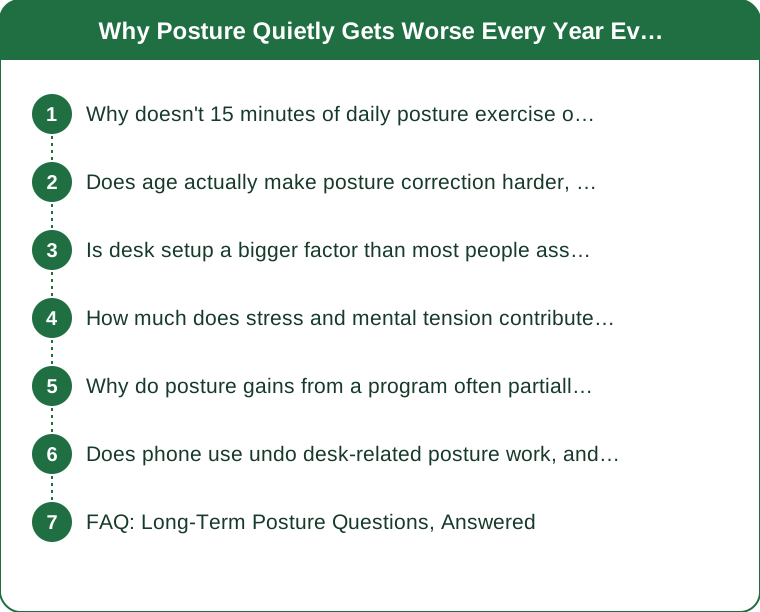
Why doesn’t 15 minutes of daily posture exercise offset 9 hours of sitting?
The core issue is volume asymmetry — even a highly effective 15-minute corrective routine is a tiny fraction of a typical 9-to-10 hour seated workday. Muscles adapt to whatever position they spend the most cumulative time in, and for most desk workers, that’s still a rounded, forward-leaning position regardless of how good the evening routine is. This doesn’t mean the exercises are wasted — it means they’re fighting an uphill volume battle unless the seated hours themselves are also addressed, even in small ways like more frequent position changes throughout the day.
Does age actually make posture correction harder, or is that a myth?
There’s a real physiological basis here, though it’s often overstated. Connective tissue becomes somewhat less elastic with age, and years of a consistent posture pattern do create more entrenched movement habits that take longer to unlearn. However, the idea that posture correction becomes ineffective with age is not supported — the timeline to see change tends to lengthen, but the underlying mechanism (muscle activation patterns and tissue adaptability) remains responsive at nearly any age, just requiring more patience and consistency than someone starting the same routine in their twenties.
Is desk setup a bigger factor than most people assume?
Yes, often larger than the exercise routine itself. A monitor positioned too low, a chair without adequate lower back support, or a keyboard placed too far away all create small compensations that add up over a full workday — compensations that no amount of evening stretching fully cancels out if they’re recreated fresh every single working day. A properly adjusted desk setup functions as a form of passive, all-day correction that active exercises simply can’t match in total hours.

How much does stress and mental tension contribute to posture decline?
More than most posture advice accounts for. Chronic stress produces sustained tension in the upper trapezius and neck muscles, pulling the shoulders up and forward independent of any structural or strength issue. This means someone can have excellent core and back strength and still present with poor posture during high-stress periods, because the pattern is being driven by nervous system tension rather than muscular weakness — a distinction that changes what kind of intervention actually helps (breathing and stress management, not just more strengthening exercises).
Why do posture gains from a program often partially reverse after stopping?
This comes down to specific adaptation to imposed demand — muscles and movement patterns adapt to whatever is consistently practiced, and once a structured program ends, the daily environment (sitting, phone use, stress) reasserts itself as the dominant influence again. This is normal and doesn’t mean the program failed; it means posture correction functions more like an ongoing practice than a one-time fix, similar to how fitness gains require continued training to maintain rather than becoming permanent after a single program.
Does phone use undo desk-related posture work, and what actually produces lasting improvement?
The head-forward position during phone use creates a distinct and often more severe loading pattern than desk work alone, since phones are frequently held lower and closer, increasing the effective weight the neck muscles have to support. For many people, cumulative phone time now exceeds desk time in daily hours, making it a comparably significant — sometimes larger — contributor to posture decline than the office desk setup that typically gets more attention.
Putting all of this together, the pattern across research and clinical practice points to addressing total daily loading time, not just adding corrective exercise volume — meaning frequent position breaks throughout the day, an ergonomically sound desk and phone-holding habit, ongoing (not time-limited) postural strength work, and attention to stress-related tension all together. No single piece — not the exercises alone, not the desk setup alone — reliably produces lasting change in isolation, which is part of why so many single-intervention attempts feel like they eventually plateau or reverse.
FAQ: Long-Term Posture Questions, Answered
Is it too late to meaningfully improve posture after years of poor habits?
No — while tissue adaptability changes somewhat with age and years of habit, meaningful improvement remains possible at essentially any point; the timeline is simply longer than someone starting fresh.
Do posture correction devices (braces, straighteners) solve the underlying problem?
They can help build awareness short-term, but they don’t build the muscular endurance needed for the posture to hold on its own, and can create dependency if relied on exclusively.
How long before daily posture habit changes show a measurable difference?
Most people notice reduced discomfort within 3-4 weeks of consistent changes, though structural, visible postural change typically takes several months of sustained practice.
TL;DR:
- Posture exercises are usually outweighed in total daily hours by sitting and phone use
- Age makes correction slower, not ineffective — the mechanism stays responsive
- Desk and phone setup often matter more than the exercise routine itself
- Stress-driven tension needs a different fix than pure strengthening work
- Lasting change requires reducing total daily loading time, not just adding corrective minutes
If posture work has felt like it’s not sticking, the missing piece is usually the other 23 hours of the day, not the routine itself — small, frequent changes to daily loading tend to outperform even a very good 15-minute exercise block done in isolation.
Keep Reading
This article is for general informational and styling purposes only. Fit, sizing, and product availability may vary.