Why Posture Cues Stop Working — and What Actually Holds Instead
Quick Answer: Posture cues fail because they rely on conscious attention, and attention is a limited resource you spend on your actual work. Anything that requires you to remember it will be dropped within minutes. What holds instead is a three-layer approach: change the environment so the position is the default, build the endurance to sustain it, and use movement frequency rather than position perfection as your target.
You have been told to sit up straight your whole life. You can do it right now. You will not still be doing it in fifteen minutes, and you know that from experience.
That is not weak discipline. It is the entirely predictable outcome of asking conscious attention to hold a position for eight hours while you also do a job.
This is the long version: why cues fade, what your body is actually doing, and the three layers that hold without you thinking about them.

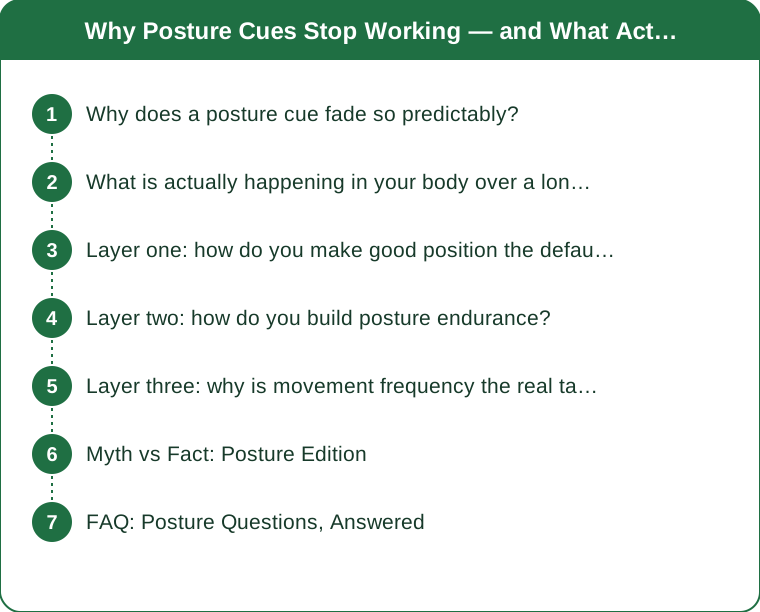
Why does a posture cue fade so predictably?
Because it competes for the same attention your work needs, and your work wins every time.
Conscious postural control is expensive. Holding a deliberate position requires ongoing motor attention. The moment a difficult email arrives, that attention is reallocated. This is not a flaw in your character — it is how a finite attentional system allocates resources to whatever is most urgent.
Your baseline reasserts itself in minutes. Studies of seated posture interventions consistently find that cue-based corrections decay within roughly 10 to 20 minutes without an external reminder. People given the same cue repeatedly do not become better at holding it; they just get corrected more often.
The cue is usually too vague to execute. Sit up straight does not specify what to do. People typically respond by extending the lower back and pulling the shoulders back hard — which is a different bad position that is more tiring than the one they started in. Effortful over-correction is not better posture; it is a briefer form of the same problem.
Discomfort motivates worse than we assume. By the time your shoulders ache at 3pm, you have already spent six hours in the position that caused it. Pain is a lagging indicator, so it arrives too late to serve as a useful correction signal.
And the position itself is not the villain. A slouched posture held for two minutes is genuinely harmless. The same posture held for three hours is the problem. Framing this as a posture-quality issue rather than a duration issue is precisely why cues fail — they target the wrong variable.
What is actually happening in your body over a long sitting day?
Tissue creep, reduced circulation, and progressive muscular fatigue — three slow processes that no amount of remembering can offset.
Connective tissue slowly deforms under sustained load. Hold any tissue at a constant length and it gradually lengthens and loses some of its elastic response. This is why your position at 4pm is measurably more collapsed than at 9am even if your intent has not changed at all. Your tissues have quietly adapted to the shape you spent the day in.
Static muscle work restricts its own blood supply. Low-level continuous contraction in the postural muscles of your upper back and neck compresses the small vessels feeding them. Metabolites accumulate, and that accumulation is a large part of the specific burning ache people describe between the shoulder blades in the afternoon.
Deep stabilizers fatigue before you feel them. The small muscles closest to the spine are endurance tissue, and they are not designed for eight continuous hours. When they fade, larger surface muscles take over — less efficiently and more tiringly — which produces the sensation that holding yourself up is suddenly hard work.
Breathing changes, and it feeds back. A collapsed rib cage reduces diaphragm efficiency, so breathing becomes shallower and more upper-chest driven. That recruits neck muscles for breathing, which adds to their existing postural load. This loop is why neck tension so often accompanies a long desk day — and why a posture cue aimed at the shoulders never touches the cause.
None of this responds to willpower. Tissue creep, circulatory restriction, and endurance limits are physiological timelines. You cannot decide your way out of them, which is exactly why the strategy has to change from remembering to restructuring.
Layer one: how do you make good position the default?
By changing the environment so that the position you want requires no effort to maintain — because it is the easiest one available.
Start with monitor height, not your back. The top of your screen should sit at or slightly below eye level. A screen that is too low pulls your head forward, and a forward head position drags everything below it into collapse. Head position is downstream of screen position, and it is the highest-leverage change in the entire setup.
Then fix elbow height. Your forearms should be roughly parallel to the floor with shoulders relaxed. Too-high a desk lifts and tenses your shoulders all day; too-low pulls you into a hunch. Adjust chair height first, and if your feet then dangle, add a footrest — a stack of books works.
Support your lower back where it actually needs it. A small cushion or rolled towel at the level of your belt line lets your pelvis sit neutral without muscular effort. This is the difference between a position you hold and a position that holds you.
Move your inputs closer. A keyboard or mouse placed too far forward pulls one shoulder into constant reach. Small reach distances quietly generate large cumulative loads.
Then check what your phone is doing to all of this. Most people undo a well-set desk during two hours of evening phone use with a fully flexed neck. Raising the phone or propping it matters as much as the desk does, and it is the most commonly ignored part of the setup.

Layer two: how do you build posture endurance?
By training the specific muscles that fail first, in the position they fail in — briefly, and often enough to matter.
Target the deep neck flexors. Lying on your back, gently nod your chin toward your chest without lifting your head, and hold 10 seconds for 8 to 10 repetitions. These muscles are the primary counter to forward head position and are almost universally underdeveloped in desk workers.
Train thoracic extension actively. Over a foam roller or the back of a chair, extend the upper back and hold 20 to 30 seconds, 3 to 5 times. Passive stretching alone gives short-lived change; adding a gentle active hold at the end range is what makes it stick.
Strengthen the mid-back through range. Rows and band pull-aparts, 2 to 3 sets of 10 to 15, twice a week. This is unglamorous and it does more for afternoon shoulder position than any cue ever will.
Do not neglect the hips. Tight hip flexors from sustained sitting tilt the pelvis and make a neutral spine harder to achieve. Two minutes of hip flexor lengthening per side removes an obstacle you may not know you have.
Keep sessions short and frequent. Ten minutes, three to four times a week, beats an hour once weekly by a wide margin. You are building endurance capacity, and endurance responds to frequency far more than to volume.
Layer three: why is movement frequency the real target?
Because the duration of any single position is the actual problem, and interrupting duration is far easier than perfecting position.
Change position every 20 to 30 minutes. Not a full break — a genuine shift. Stand, lean back, cross your legs the other way, take a call standing. What matters is that the loaded tissues change which tissues are loaded.
Two minutes is plenty. The point is to reset tissue creep and restore circulation, not to complete a workout. Brief and frequent beats long and rare, every time.
Attach the shift to something that already happens. End of a meeting, sending an email, refilling water. Habits that piggyback on existing events survive; habits that need their own reminder do not.
Let the variety include positions you have been told are bad. Slouching for four minutes is not a moral failure — it unloads what has been loaded. The healthiest posture strategy is a rotation, not a single correct shape.
Use a timer only at the start. Two weeks of an external prompt is usually enough for the shifts to become automatic, at which point the timer becomes annoying and you can drop it. This is the one place where a reminder genuinely works, because it triggers an action rather than asking you to sustain a state.
Myth vs Fact: Posture Edition
Myth: There is one correct posture. Fact: the best-supported view is that variety matters more than any single alignment. Sustained duration in any one position is the reliable predictor of discomfort.
Myth: Slouching damages your spine. Fact: brief slouching is a normal, unloading position. The evidence links prolonged static loading — of any kind — to discomfort far more strongly than it links any particular shape to damage.
Myth: A better chair will fix your posture. Fact: an expensive chair set up wrong is worse than a basic chair set up right. Monitor height, elbow height, and movement frequency all outrank the chair itself.
Myth: Core strength is the answer. Fact: core strength helps, but the muscles that actually fail on a desk day are the deep neck flexors and mid-back endurance muscles. Plenty of strong-core people have miserable afternoon posture.
Myth: Posture is about appearance. Fact: the useful goal is comfort and endurance across a full day. Chasing a look tends to produce stiff over-correction that fatigues faster than the original slouch did.
FAQ: Posture Questions, Answered
How long until I notice a difference?
Environmental changes — monitor and desk height — can change how your afternoon feels within a day or two. Endurance work takes 4 to 6 weeks of consistent short sessions before it holds without attention. Movement frequency helps immediately and becomes automatic in around two weeks.
Is a standing desk the solution?
Only if you alternate. Standing all day produces its own set of complaints, particularly in the feet and lower back. The benefit comes from being able to change position easily, not from standing itself. Aim for a rotation rather than a replacement.
Should I use a posture corrector brace?
They provide a useful tactile reminder for short periods but they do not build capacity, and long-term reliance can reduce the very muscular work you are trying to develop. Short sessions as a feedback tool are reasonable; all-day wear is not the path.
My shoulders ache no matter what I do. What next?
Check three things in order: monitor height, mouse reach distance, and whether you are shrugging because your desk is too high. If all three are right and the ache persists for more than a few weeks, or if you have numbness, tingling, or weakness in an arm, get it assessed.
This is general information, not medical advice. Persistent pain, numbness, tingling, or weakness warrants evaluation by a qualified professional.
TL;DR:
- Cues fail because conscious attention is limited and your work will always outbid your posture for it.
- The real variables are duration, tissue creep, circulation, and endurance — none of which respond to remembering.
- Layer one: fix the environment. Monitor at or just below eye level, forearms parallel to the floor, lumbar support, inputs close, and deal with phone posture too.
- Layer two: build endurance. Deep neck flexor holds, active thoracic extension, mid-back rows, hip flexor length — 10 minutes, 3 to 4 times a week.
- Layer three: change position every 20 to 30 minutes for two minutes, attached to something that already happens in your day.
- Variety beats perfection. A rotation of positions, including relaxed ones, is the goal.
The reason posture advice has never worked for you is that almost all of it targets the one thing that cannot be sustained — your attention. Move the target to your environment, your endurance, and how often you change shape, and good position stops being something you have to remember.
Keep Reading
This article is for general informational and styling purposes only. Fit, sizing, and product availability may vary.