Why Posture Corrections Work for Two Days and Then Vanish
Quick Answer: Posture corrections fade because holding a position consciously uses attention, which is a limited resource, while maintaining it automatically requires postural endurance in the deep stabilising muscles, which takes 6 to 12 weeks to build. The correction works for two days because attention is fresh, then vanishes the moment something demands your focus. Lasting change comes from short frequent position changes and endurance work, not from holding one better position harder.
Monday you fixed it. You felt taller and it was obvious to you all day.
By Wednesday you had to keep reminding yourself. By Thursday you had stopped noticing.
Nothing about you failed. The method did.

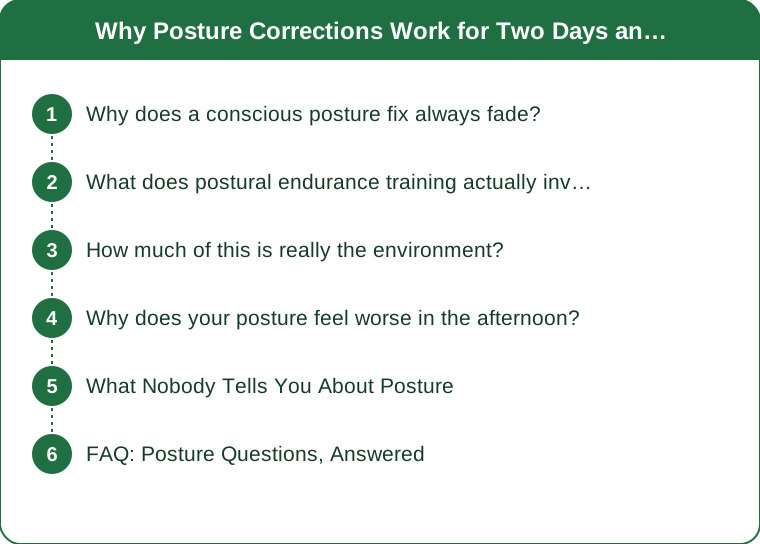
Why does a conscious posture fix always fade?
Because you are recruiting the wrong system to do a job it cannot sustain.
Conscious correction runs on attention, and attention is finite. Holding a position deliberately competes directly with whatever you are actually trying to do. The moment a task becomes demanding, posture is what gets dropped — not because you stopped caring, but because attention is a genuinely limited resource and your brain allocated it to the task in front of you.
Postural muscles are endurance tissue and they are trained slowly. The deep stabilisers of the spine — multifidus, transversus abdominis, the deep neck flexors — are dominated by slow-twitch fibres built for hours of low-level work. Building measurable endurance in these muscles takes 6 to 12 weeks of consistent low-intensity work. Two days of sitting up straight does not touch them.
The correction is usually too big. People typically overcorrect into an exaggerated upright position that requires far more effort than sustainable posture actually does. A position that costs effort will always be abandoned; a position that costs almost nothing will persist. Good posture, done properly, feels less effortful than the slouch it replaced — not more.
Fatigue accumulates through the day on a predictable curve. Postural endurance measurably declines over a working day, which is why almost everyone reports worse posture in the afternoon than the morning regardless of intention. You are not failing at 3pm; you are running out of the specific tissue capacity the position requires.
Your environment votes constantly and you only vote occasionally. A monitor 10cm too low, a chair without forearm support, a laptop on a kitchen table — these apply their influence for every one of the eight hours. Your conscious correction applies for perhaps forty minutes of that. The environment wins on volume alone.
And there is no single correct posture to hold anyway. Current thinking in the field has moved away from a single ideal position and toward movement variability. The healthiest posture is the one you keep changing. Trying to hold one perfect position, even the right one, is itself part of the problem.
What does postural endurance training actually involve?
Not what most people expect, and considerably less dramatic.
Low load, long duration, high frequency. Postural muscles respond to sustained low-level activation rather than heavy effort. Think 30 to 60 second holds repeated through the day, not three sets to failure once a week.
Specific exercises with good evidence behind them. Deep neck flexor training (a gentle chin nod held for 10 seconds, repeated 10 times), prone or standing thoracic extension over a support, side plank progressions for lateral chain endurance, and simple wall-supported scapular work. None of these are impressive-looking and all of them are effective.
Daily beats intense. Five minutes daily produces far better postural adaptation than forty minutes twice a week, because the tissue you are targeting is designed for frequent low-level demand. This is the opposite of how strength training works, which is why people who train hard are often confused that it has not helped their posture.
Thoracic mobility usually has to come first. If the upper back cannot extend, no amount of endurance work will let you sit upright without compensating somewhere else. A stiff thoracic spine forces the correction into the lower back or neck, which is why some people find their ‘better’ posture actually causes new discomfort.
Expect the timeline to be 6 to 12 weeks, with the first change at about 3 weeks. The first noticeable sign is not that your posture looks different but that holding it stops requiring thought for progressively longer stretches. That is the actual marker of progress and it is easy to miss if you are watching the mirror instead.
Strength work supports it but does not replace it. Rows, face pulls and carries build the capacity that endurance work then teaches you to use continuously. Both matter; neither alone is enough.
How much of this is really the environment?
More than most people are willing to accept, and the fixes are unglamorous.
Monitor height is the highest-value change available. The top of the screen should sit at or just below eye level. A monitor too low produces sustained neck flexion for hours, and no amount of conscious correction survives that geometry. A stack of books solves it in thirty seconds.
Forearm support changes shoulder position immediately. Resting forearms on the desk or armrests removes the sustained load from the upper trapezius. Unsupported arms weigh several kilograms each and the shoulders carry that all day.
Chair height sets everything below the waist. Hips slightly above knees, feet flat. If feet dangle, the pelvis rotates back and the whole spine follows. A footrest, or a box, fixes a surprising amount.
Laptop use is structurally incompatible with good posture. The screen and the keyboard cannot both be in the right place. For anything over an hour, an external keyboard or a laptop stand is not a luxury — it is the only way to make the geometry work at all.
Position changes matter more than any single position. Standing, perching, walking, reclining. Aim to change position every 30 minutes, which is better supported by evidence than any specific sitting posture.
Phone use adds a substantial daily dose. Sustained neck flexion looking down at a phone loads the cervical spine considerably, and the average person accumulates hours of it. Raising the phone toward eye level is free and most people have never tried it consistently.

Why does your posture feel worse in the afternoon?
Because several separate curves all bottom out at the same time.
Postural muscle endurance declines through the day. This is measurable and expected. The same position that was easy at nine genuinely costs more at three.
Spinal discs lose height through the day. You are measurably shorter in the evening than the morning as discs gradually lose fluid under load. This changes spinal mechanics slightly and contributes to that end-of-day compressed feeling.
Attention is depleted. The same cognitive resource that maintains conscious posture is spent on work. By afternoon there is less of it available for anything optional.
Position duration accumulates. By 3pm most people have been in broadly the same configuration for hours, and tissue creep — the gradual lengthening of soft tissue under sustained load — is well established.
Blood glucose and general fatigue play a part. The mid-afternoon dip affects postural vigilance like it affects everything else.
The practical response is scheduling, not effort. Rather than trying to concentrate harder in the afternoon, put a two-minute movement break at 2pm and 4pm in the calendar. Working with the curve is far more effective than trying to override it.
What Nobody Tells You About Posture
Perfect posture is not a real target. The research consensus has moved decisively toward variability. The best posture is your next one, and the goal is a wider range of comfortable positions rather than one ideal held longer.
Posture and pain are less connected than assumed. Large studies have repeatedly found weak correlation between measured postural deviations and back or neck pain. Plenty of people with textbook posture have pain, and plenty with poor posture do not. This is genuinely reassuring, and it means the goal is comfort and capacity rather than compliance with a diagram.
Posture braces make things worse over time. They provide passive support, and the muscles that would otherwise do that job reduce their activity. Short-term relief, long-term dependency.
Sitting is not the villain it is described as. Prolonged static positioning is the issue, and standing still for eight hours produces its own problems. The variable that matters is movement frequency.
Feeling taller is not evidence of correction. Most people’s instinctive fix is a thoracic extension plus a chin lift, which feels dramatic and is largely unsustainable. Real change is subtle and mostly unnoticeable in the mirror.
And the one that surprises everyone: the most effective posture intervention is usually a timer. Not an exercise, not a chair, not a brace. A prompt every 30 minutes to change position outperforms almost everything else people spend money on.
FAQ: Posture Questions, Answered
How long does it really take to change posture?
Measurable endurance change takes 6 to 12 weeks of daily low-level work. The earliest sign, at around three weeks, is that holding the position requires less conscious thought.
Do posture correctors work?
They work while worn and tend to reduce muscle activity over time. Useful as a short-term reminder, counterproductive as a long-term strategy.
Is my bad posture causing my back pain?
Possibly, but the evidence for a direct link is much weaker than commonly assumed. Sustained static loading and low movement variability are more consistently associated with discomfort than any specific posture.
What is the single best change I can make?
Raise your monitor to eye level and set a 30-minute movement timer. Together those two cost nothing and outperform most other interventions.
Should I sit or stand?
Both, alternating. Neither is good for eight hours. A rough starting split is 20 minutes standing per hour.
Why does good posture feel tiring?
Usually because the position is overcorrected. Sustainable upright posture should feel easier than slouching, not harder. If it burns, you are holding too much.
This is general information, not medical advice. Persistent neck or back pain, numbness, or pain radiating into an arm or leg is worth seeing a physiotherapist or doctor about rather than working on alone.
TL;DR:
- Conscious posture fixes fade because they use attention, which is finite, rather than postural endurance, which takes 6 to 12 weeks to build.
- Train it with low-load, 30 to 60 second holds, daily — not hard sessions twice a week.
- Environment beats willpower: monitor at eye level, forearms supported, feet flat, external keyboard for laptops.
- Afternoon decline is normal and predictable — schedule movement breaks rather than concentrating harder.
- There is no single correct posture; variability and changing position every 30 minutes is the actual goal.
Set a 30-minute timer and raise your monitor today. Both are free, and between them they do more than months of trying to sit up straight.
Keep Reading
This article is for general informational and styling purposes only. Fit, sizing, and product availability may vary.