Why Every Posture Correction You Make Fades Within Twenty Minutes
Quick Answer: Conscious posture correction uses voluntary muscular effort, and voluntary effort fatigues within minutes. Posture defaults are set by habitual position, environmental setup, and how much variation your day contains — not by how often you remember to sit up straight. Changing the default requires changing those inputs, because the reminder approach is fighting a system it can’t win against.
You’ve done this a hundred times. You catch yourself slumped, straighten up, feel briefly virtuous, and twenty minutes later you’re back exactly where you started. That cycle isn’t a discipline failure — it’s what happens when you use a conscious system to solve an unconscious problem.

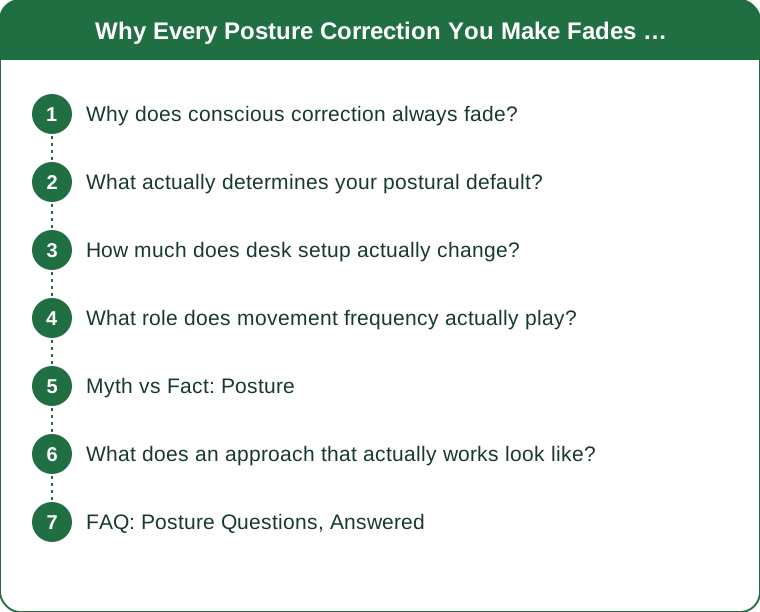
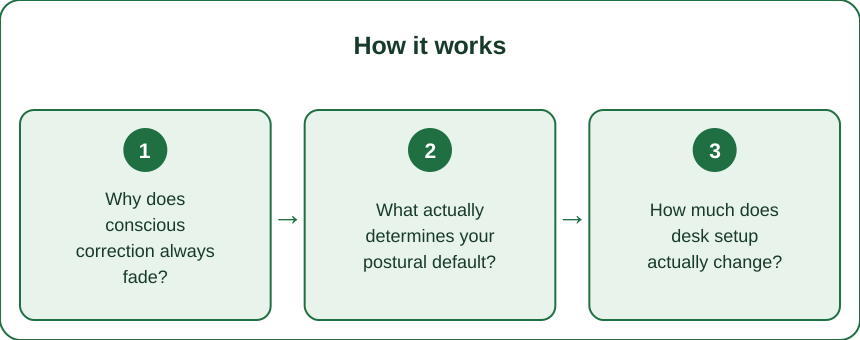
Why does conscious correction always fade?
Posture at any given moment is the product of two systems working on very different budgets. The first is voluntary: you decide to sit upright and recruit muscles to do it. The second is postural tone — a largely unconscious, continuously regulated background system that maintains position without your attention and without meaningful fatigue.
Voluntary muscular effort has a hard limit. Holding a deliberately upright position recruits muscles at a level they can’t sustain, and as attention shifts to whatever you were actually doing, the voluntary contribution drops away and the unconscious default reasserts itself. This isn’t willpower failing — it’s the correct and expected behavior of a system designed to run without conscious input.
The attention problem
There’s a second constraint stacked on the first. Posture correction requires ongoing attention, and attention is a genuinely limited resource that your actual work is already consuming. A reminder can interrupt attention briefly, but it can’t hold it, which is why phone-based posture reminders reliably produce a spike in correction followed by a return to baseline within minutes.
The implication is uncomfortable but useful: any approach that requires you to remember something is structurally incapable of changing a default. Defaults are, by definition, what happens when you aren’t remembering.
What actually determines your postural default?
Three inputs, roughly in order of leverage.
Environmental geometry is the largest. Where your screen sits relative to your eyes, where your keyboard sits relative to your elbows, and how your chair supports your pelvis together determine what position is mechanically easiest. Your body reliably finds the lowest-effort position available in whatever environment it’s in, and no amount of conscious correction outcompetes geometry over an eight-hour day.
Movement frequency is second and badly underrated. Postural muscles fatigue with sustained static holding regardless of how good the position is, which means even excellent posture degrades if it’s held motionless for long enough. Position variation is what prevents that, which is why the standing-desk-versus-sitting debate largely misses the point — the problem is staticness, not the specific posture.
Tissue adaptation is third and slowest. Positions held for years produce genuine adaptive changes in muscle length, tissue stiffness, and motor patterning. This is real, but it operates on a timescale of months and is the least useful place to start, despite being where most posture advice focuses.
Why the order matters
Most people attack this list in exactly reverse order — stretching first, movement reminders second, and environment last if at all. Flipping the order tends to produce noticeable change in days rather than months, because you’re changing what your body defaults to instead of trying to override it.
How much does desk setup actually change?
More than any other single intervention, and the specific numbers matter.
Monitor height is the main lever. The top of the screen sitting at or slightly below eye level means your neck holds a roughly neutral position by default. A laptop screen on a desk sits far below that, forcing a forward head position that then propagates down through the upper back. A laptop stand plus an external keyboard genuinely resolves more neck complaints than any exercise program, and it costs less than one physio session.
Chair height and depth set the pelvis, which sets everything above it. Feet flat with knees at roughly 90 degrees, hips level with or slightly above knees, and lumbar support meeting the natural curve of your low back gives the pelvis a stable base. When the pelvis rolls backward — which is what happens in a too-deep or too-low chair — the whole spine above it rounds to compensate, and no amount of chest-opening fixes a pelvis problem.
Keyboard and mouse position determine shoulder posture. Reaching forward or out to the side pulls the shoulders into protraction and internal rotation for hours at a time. Elbows near the body at roughly 90 degrees is the target, and it’s usually achieved by moving the keyboard closer rather than by moving yourself.
The single highest-value change
If you change exactly one thing, raise the screen. Neck position is downstream of screen height for almost everyone, and the fix is passive — it works whether or not you’re paying attention, which is the entire point.

What role does movement frequency actually play?
A large one, and it’s the input people find most surprising. Research on prolonged static postures consistently points toward duration as an independent factor — the same position that’s fine for 20 minutes produces discomfort at 90, regardless of how correct that position is.
The underlying reason is straightforward: muscles held at a constant length under constant low load fatigue and lose their ability to maintain that length. Blood flow through statically contracted tissue is also reduced, which compounds the effect over hours.
A useful frame: your best posture is your next posture. Position changes every 20-30 minutes matter more than achieving a single perfect position and defending it. That can be as small as shifting how you sit, standing for a phone call, or walking to refill water.
Making it automatic rather than remembered
Since remembering is the failure mode, tie movement to things that already happen. Stand for every phone call. Fill a smaller water glass so refills come more often. Take stairs to a different floor’s bathroom. Each of these changes the environment so the movement happens without a decision — the same principle as the desk setup, applied to time instead of space.
What counts as a position change
Less than people assume. You don’t need a walk or a stretch routine. Shifting from sitting back to sitting forward, crossing and uncrossing legs, standing to read something on the screen, or simply leaning to one side for thirty seconds all qualify, because they redistribute load to different tissue.
This is worth knowing because the bar most people set — get up and walk every half hour — is high enough that it doesn’t survive a busy week. A bar you can clear during a meeting you can’t leave is the one that actually changes anything. The goal is load variation, and load variation is cheap.
Myth vs Fact: Posture
Myth: There’s one correct posture everyone should hold. Fact: Optimal posture varies with individual anatomy, and the research increasingly emphasizes variation over any single ideal position. A range of reasonable positions cycled through beats one perfect position held.
Myth: Slouching causes back pain directly. Fact: The relationship between static posture and pain is far weaker than commonly assumed. Prolonged static loading of any kind, plus overall physical capacity, appear to matter more than the specific shape you hold.
Myth: Posture braces retrain your muscles. Fact: Braces provide external support, which is a passive substitute rather than a training stimulus. They can be useful as a short-term awareness cue but don’t produce lasting change on their own.
Myth: Core strength automatically fixes posture. Fact: Strength provides capacity, not default position. Plenty of very strong people have poor postural defaults, because default is set by habit and environment rather than by maximum available force.
Myth: Standing desks solve the problem. Fact: Static standing produces its own fatigue pattern and its own complaints. The benefit of a sit-stand desk is the transition between positions, not the standing itself — which means a desk you never adjust delivers almost nothing.
Myth: You can undo years of desk work with a stretching routine. Fact: Stretching changes tissue tolerance somewhat but doesn’t change the eight hours a day that created the default. Environment first, then movement, then tissue work.
What does an approach that actually works look like?
Build it in the order of leverage, and expect it to feel almost too easy.
Week one: fix the geometry. Screen to eye level, keyboard close, chair set so feet are flat and the pelvis is supported. This is a one-time change that then works passively, forever, without attention. Measure it once rather than eyeballing it — most people’s screens are several inches lower than they estimate.
Week two: build in movement triggers. Pick three things that already happen daily and attach a position change to each. The goal is a position change every 20-30 minutes without needing a reminder app.
Week three onward: add capacity work. Now tissue work earns its place — thoracic mobility, upper back strength, hip flexor length. Roughly 10 minutes, three times a week, is sufficient at this stage because it’s supporting a default that’s already better rather than fighting one that isn’t.
What progress actually looks like
Not a permanently upright posture. What changes is where you find yourself when you aren’t thinking about it, and how long you can work before discomfort shows up. If you catch yourself slumped less often — rather than correcting it faster — the default has moved. That’s the only measure that means anything here.
When to get it looked at
Persistent pain, numbness, tingling, or symptoms radiating into the arms or hands are not posture problems to solve with a monitor stand. Those warrant assessment from a physical therapist or physician, and the posture conversation comes after that, not instead of it.
FAQ: Posture Questions, Answered
How long does it take to change a postural default?
Environmental changes take effect immediately, since they change what’s mechanically easiest right away. Tissue adaptation from years of a position takes months. Most people notice meaningful change within two to four weeks of fixing setup and movement frequency.
Do posture-correcting exercises work at all?
They build capacity, which is genuinely useful — but capacity alone doesn’t change what your body defaults to for eight hours a day. They work best layered on top of environmental changes rather than instead of them.
Is forward head posture actually as harmful as it’s described?
The dramatic claims about equivalent head weight at various angles describe a calculation, not a measured health outcome. Forward head position is associated with neck discomfort in many people, but the alarmist framing outruns the evidence.
What about sleeping position?
It matters less than waking posture for most people, simply because you’re not producing sustained voluntary effort while asleep. Pillow height affecting neck position is the piece worth attending to.
Can I fix this without buying anything?
Often yes. A stack of books raises a laptop as well as a stand does, and pulling a keyboard closer costs nothing. The geometry matters, not the equipment.
TL;DR:
- Conscious correction uses voluntary effort, which fatigues within minutes — it can’t change a default
- Defaults are set by environment first, movement frequency second, tissue adaptation third
- Most people work that list backward, which is why progress feels so slow
- Raising your screen to eye level is the single highest-leverage change available
- Position variation every 20-30 minutes matters more than any single perfect posture
- Progress means catching yourself slumped less often, not correcting faster
Stop trying to remember. Change what your body finds easiest and the reminders stop being necessary — which was always the only version of this that was going to hold. Persistent pain, numbness, or tingling is a reason to see a professional rather than to rearrange a desk. This is general information, not medical advice.
Keep Reading
This article is for general informational and styling purposes only. Fit, sizing, and product availability may vary.