The 3-Minute Morning Posture Reset
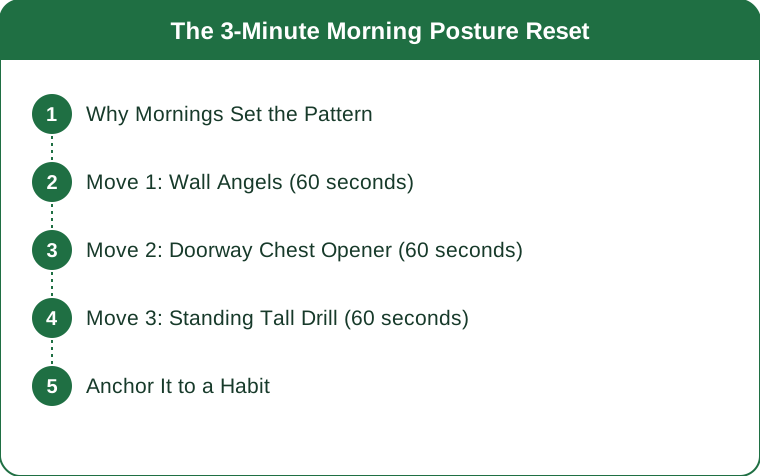
Quick Answer: Three moves, one minute each, right after you brush your teeth: wall angels to wake the upper back, a doorway chest opener to undo the night’s curl, and a 60-second tall-stand rehearsal to set the pattern. Total time: 3 minutes. Do it daily and “upright” becomes the default your body returns to.
Posture doesn’t get decided at your desk at 3pm. By then you’re just executing a shape your body set hours earlier.
You spent seven hours curled sideways. Tissues stiffened in that position, your chest shortened, your upper back went quiet. Then you got up and carried all of it straight to a chair.
Three minutes changes what shape you’re carrying. Here’s the whole reset — it takes less time than your coffee.

Why does morning posture matter more than desk posture?
Because you’re setting a default rather than correcting one.
Overnight, soft tissue adapts to whatever position you held. Most people sleep with shoulders rounded forward and hips flexed — the same shape a desk chair produces, held for eight hours with no interruptions. Wake up, stand up, and you’re already in the position you’d be trying to fix at noon.
There’s also a neuromuscular piece. The muscles that hold you upright — mid and lower trapezius, rhomboids, deep neck flexors — are endurance muscles that respond to being switched on rather than being strengthened hard. A few minutes of deliberate activation in the morning noticeably changes how easily you find that position later.
Three intentional minutes beat eight passive hours of trying to remember. You cannot willpower your way to good posture at 3pm. You can prime it at 7am.
Move 1: Wall Angels (60 seconds)
Stand with your back against a wall — heels a few inches out, low back, upper back, and head all touching. Arms up in a goalpost position, backs of the hands against the wall.
Slide the arms up overhead and back down, keeping hands and forearms in contact with the wall the entire time. Ten slow reps, about 6 seconds each.
This wakes the mid-back muscles that actually hold you upright. If your hands lift off the wall, that’s the point — you’ve found exactly where your mobility runs out. Go only as far as contact allows and the range improves within a couple of weeks.

Move 2: Doorway Chest Opener (60 seconds)
Forearms flat on both sides of a doorframe, elbows at roughly shoulder height. Step gently through with one foot until you feel a stretch across the front of the chest.
Two rounds of 30 seconds. Breathe wide into the ribs rather than the belly.
Sleep and screens both shorten the front of the chest — pecs and the front of the shoulder. When those are tight, they pull the shoulders forward and no amount of “sit up straight” wins that fight. This reopens the front so the back has something to work against.
Adjust the elbow height to change where you feel it: higher hits the lower chest fibers, lower hits the upper ones. Stop well short of anything sharp.
Move 3: Standing Tall Drill (60 seconds)
Stand normally. Imagine a string lifting the crown of your head. Stack ribs directly over hips — most people’s ribs flare forward — and let the shoulders melt down and back rather than yanking them.
Hold and breathe for ten slow counts. Twice.
This one looks like nothing and it’s arguably the most useful of the three, because it’s rehearsal. You’re teaching your nervous system what “tall” feels like when you’re not actively thinking about it. That’s the sensation you’ll recall at your desk later — and you can only recall something you’ve practiced.
How do I make it stick?
Habit-stack it. Attach the reset to something you already do without deciding.
Right after brushing your teeth is the reliable slot — you’re already standing, already in a bathroom with a doorframe, and the trigger fires every single morning without needing a reminder. Most people report it going automatic within about two weeks.
What not to do: put it in a calendar as its own event, or plan to do it “sometime in the morning.” Free-floating habits die. Anchored ones survive.
One useful side effect: your afternoon slouch alarm starts ringing earlier. Once your body knows what upright feels like, being folded over a laptop starts registering as uncomfortable rather than normal. That’s awareness winning, and it does more for your posture than the exercises themselves.
Wear something you can move in, obviously — this happens before you’re dressed for most people, which is part of why it works.
FAQ
How long does it take to improve posture?
Most people notice they can find and hold an upright position more easily within 2–3 weeks of daily work. Actual strength and tissue changes in the mid-back take longer — usually 8–12 weeks. Awareness improves first, and it’s awareness that does most of the day-to-day work.
Can you fix posture with just three minutes a day?
Three consistent minutes daily beats a 30-minute session you do twice a month, because posture is a pattern rather than a fitness level. For significant postural issues, add two short strength sessions a week with rows and pull-aparts — but the daily reset is what changes your default.
Should I do posture exercises in the morning or evening?
Morning, if you’re choosing one. You’re setting the pattern your body carries all day rather than correcting one at the end of it. An evening session is a fine addition for undoing a desk day, but it doesn’t do the priming job.
TL;DR:
- Morning sets your postural default; the desk just executes it.
- Wall angels (60s) wake the mid-back that holds you upright.
- Doorway opener (60s) undoes the overnight and on-screen chest shortening.
- Tall-stand drill (60s) rehearses the feeling you’ll need to recall later.
- Anchor it right after brushing your teeth — anchored habits stick, free-floating ones don’t.
Keep Reading
This article is for general informational and styling purposes only. Fit, sizing, and product availability may vary.