The Complete Guide to Posture When You Are on Your Feet All Day
Quick Answer: Posture for people who stand all day is a fatigue-management problem, not an alignment problem. Your body will not hold one position for eight hours regardless of how good that position is, so the goal is planned variation — shifting stance, using a footrest, changing weight distribution, and building the specific endurance that lets your postural muscles last a shift. Trying to hold a textbook standing position is the fastest route to the ache you are trying to avoid.
This guide covers what actually fails during a long shift, in what order, and what to do about each stage.

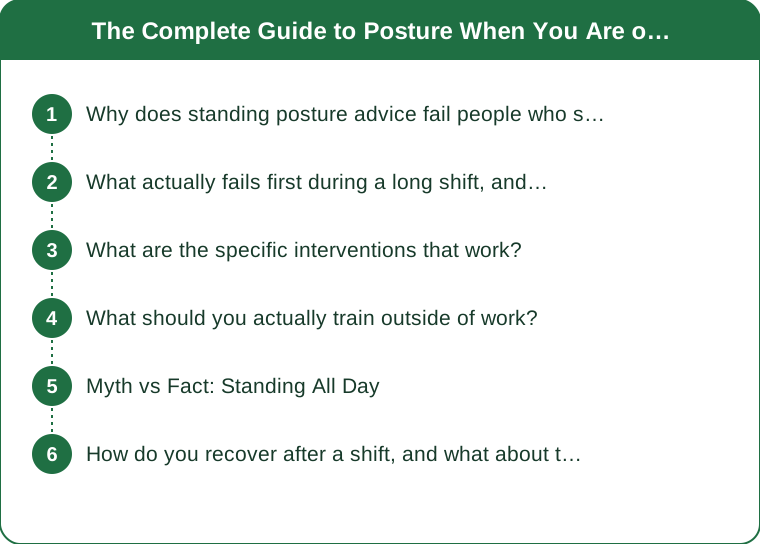
Why does standing posture advice fail people who stand for a living?
Because nearly all of it is written to correct sitting, and the failure mode is entirely different.
The standard posture correction — shoulders back, chest up, core braced, pelvis neutral — is a set of instructions for someone who has been collapsed in a chair. It is a corrective posture, and it is designed to be held briefly to counteract hours of the opposite.
A corrective posture is not a resting posture. It costs muscular effort to maintain. Hold it for ten minutes and it feels good. Hold it for six hours and you have simply moved fatigue from one set of muscles to another, usually the lower back and the calves.
The second reason the advice fails is that it treats one position as correct. For someone standing all day, the correct position is the one you are not currently in. Tissue tolerance is time-dependent — any position, however well aligned, becomes uncomfortable when held long enough, because sustained loading restricts blood flow to the loaded tissue and metabolites accumulate.
The third reason is that it ignores the surface. A nurse on vinyl over concrete, a stylist on tile, a teacher on carpet, and a barista on a rubber mat are having four different physical experiences from the same nominal activity. Floor surface is arguably a larger variable than spinal alignment for this population, and it is almost never mentioned in posture content.
What replaces the standard advice is a framework built around variation, unloading, and endurance. You are not trying to find the right position. You are trying to avoid staying in any one of them.
What actually fails first during a long shift, and in what order?
There is a predictable sequence, and knowing it lets you intervene before the pain stage.
Stage one, roughly the first two hours: nothing. You feel fine. This is the window where good habits cost nothing and pay the most, and it is exactly the window everyone ignores.
Stage two, hours two to four: calves and feet. The first genuine sensation is usually foot fatigue and calf tightness. Standing still means the calf muscles are working continuously as postural stabilizers with very little movement, which restricts the pumping action that normally clears blood from the lower leg. Feet begin to feel hot and swollen.
Stage three, hours four to six: the hip and lower back. As the feet get uncomfortable, you start shifting weight to one side — almost always the same side. That produces a hip hike, a lateral pelvic tilt, and asymmetric loading of the lumbar spine. This is the stage where most standing-related back pain is actually generated, and it is a consequence of the foot problem rather than a spinal problem in its own right.
Stage four, hours six to eight: upper back and neck. With the lower body fatiguing, the trunk starts to sag. The ribcage drops, the upper back rounds, and the head moves forward to compensate. Any task requiring hands in front of the body — which is most standing jobs — accelerates this considerably.
Stage five, after the shift: the rebound. Sitting down after eight hours of standing feels wonderful and often produces stiffness within twenty minutes, as tissues that were loaded in one pattern suddenly go slack.
The practical value of this sequence is that intervening at stage one or two prevents stages three and four entirely. Almost nobody intervenes before stage three, because stage three is when it starts to hurt.
What are the specific interventions that work?
Five, ordered by how much they return for the effort involved.
One: the footrest, or anything you can put one foot up on. This is the single highest-value intervention available and it is essentially free. Placing one foot on a low rail, box, or step — even four to six inches — reduces the lumbar extension load substantially by allowing the pelvis to rotate posteriorly on that side. Alternate feet every ten to fifteen minutes.
If your workplace has a rail, it is not decorative. If it does not, a sturdy box, a lower shelf, or the base of a fixture will work.
Two: deliberate stance changes on a schedule. Not when you feel uncomfortable — before. A simple rotation is feet parallel and hip-width, then one foot slightly forward, then the other, then wider, cycling every ten minutes or so. The point is not that any of these positions is better. It is that changing distributes the load across different tissues.
Three: calf raises, in place, ten to fifteen reps, several times a shift. This directly addresses the stage-two problem by activating the calf muscle pump and clearing pooled blood from the lower leg. It takes fifteen seconds and it visibly delays foot fatigue.
Four: shoes and surface. A cushioned anti-fatigue mat where you stand most is a genuine change to the physics of the situation. Shoes matter enormously here, and the relevant property is not arch support in the abstract but whether the shoe is appropriate for eight hours on a hard floor — which usually means adequate cushioning, a stable heel, and enough room that your toes are not compressed as your feet swell through the shift.
Five: walking, even briefly. Two minutes of walking does more for standing fatigue than five minutes of standing still with better alignment. If your job includes any movement, distributing it through the shift rather than clustering it is worth planning.

What should you actually train outside of work?
Endurance in the specific muscles that give out, plus mobility in the joints that stiffen.
Calf and foot endurance is the highest priority. Standing calf raises, three sets of 15 to 20, two or three times a week, progressing to single-leg. This is the tissue doing the most continuous work during a shift and the one most people never train. Add a set of toe raises for the front of the shin, which fatigues more than people realize during prolonged standing.
Lateral hip strength, because that is what fails at stage three. Side-lying leg raises, banded lateral walks, or single-leg stance work. The gluteus medius is what prevents the hip drop that produces the asymmetric lumbar loading, and it fatigues predictably during a long shift. Three sets of 12 to 15 per side, twice a week, produces a noticeable difference within a month.
Trunk endurance rather than trunk strength. For this population, holds beat heavy lifting. Side planks, dead bugs, and bird dogs build the capacity to maintain trunk position over hours, which is the actual demand. Aim for time under tension — three sets of 30 to 45 seconds — rather than difficulty.
Hip flexor and calf mobility, because both shorten under prolonged standing. A couch stretch or half-kneeling hip flexor stretch and a straight-leg calf stretch, 30 to 45 seconds each side, most days.
Deliberately spend time in positions your job never uses. If you stand upright all day, the counter-position is a deep squat, a supported forward fold, or lying on the floor with legs elevated. Ten minutes in the evening.
The common thread is that this is endurance training for a job that is endurance work. Treating standing all day as a strength problem produces the wrong program.
Myth vs Fact: Standing All Day
Myth: Standing is healthier than sitting, so a standing job is good for your back. Fact: Prolonged standing has its own well-documented associations with lower back discomfort and lower limb issues. The healthy option is neither standing nor sitting but alternating. A job that mandates one of them for eight hours is a demand to manage, not a health benefit.
Myth: If your posture is correct, you should not get sore. Fact: Any sustained position produces discomfort given enough time, regardless of alignment. Soreness after a long shift is a loading duration problem first and an alignment problem a distant second.
Myth: Compression socks are for circulation problems. Fact: They are widely used by people who stand for a living precisely because prolonged standing causes venous pooling in the lower leg. Many people who stand all day find graduated compression makes a meaningful difference to end-of-shift leg fatigue.
Myth: Expensive supportive shoes solve it. Fact: Shoes help substantially and cannot compensate for eight hours in one position on a hard surface. Shoes plus a mat plus stance variation is the combination that works; shoes alone is the version most people try.
Myth: Leaning on the counter is bad posture. Fact: Leaning is unloading, and unloading is exactly what you need periodically. Leaning on the same side every time is the problem — alternating sides makes it a useful tool rather than a habit that builds asymmetry.
Myth: You should never lock your knees. Fact: Momentary knee extension is fine and briefly restful. Standing with knees locked continuously is the issue, because it removes the muscular contribution and dumps load onto passive structures.
How do you recover after a shift, and what about the days off?
Recovery after standing is about reversing the specific loading pattern, not general rest.
Elevate the legs for ten to fifteen minutes. Legs up a wall or on a sofa arm. This directly addresses the venous pooling that accumulated through the shift and is the single most effective end-of-shift intervention. It does more than a hot bath, and it costs nothing.
Move before you sit down for the evening. A ten-minute walk after a standing shift sounds counterproductive and is not. Walking uses the calf pump and moves the joints through range, which is what stiff, statically loaded tissue needs. Going straight from eight hours standing to three hours sitting is the transition that produces next-morning stiffness.
Do the mobility work in the evening, not the morning. Hip flexors and calves respond better after they have been loaded, and evening work reduces the stiffness you would otherwise wake up with.
Change shoes as soon as you get home — not into slippers with no structure, but into something different from what you stood in. Varying the footwear varies the loading pattern through the foot.
On days off, do not spend the day sitting to compensate. The instinct after a standing shift is total rest, and the better version is different activity. Walking, cycling, swimming — anything that uses the legs dynamically rather than statically.
Watch the asymmetry. If one side aches consistently — one hip, one lower back, one calf — that is the tell that you have a habitual standing side. Deliberately practicing the opposite stance at work is more effective than stretching the sore side at home.
This is general information, not medical advice. Persistent pain, numbness, swelling that does not resolve overnight, or leg pain with warmth or redness should be assessed by a professional rather than managed with stance changes.
TL;DR:
- Standing all day is a fatigue problem, not an alignment problem — no position survives eight hours.
- The failure sequence is feet and calves, then hip and lower back from one-sided weight shifting, then upper back and neck.
- The highest-value interventions are a footrest to alternate feet on, scheduled stance changes, calf raises during the shift, and a mat plus proper shoes.
- Train calf endurance, lateral hip strength, and trunk holds; recover by elevating legs and walking rather than sitting straight down.
Start with the footrest and the ten-minute stance rotation. Those two cost nothing, and they prevent the stage where it actually starts to hurt.
Keep Reading
This article is for general informational and styling purposes only. Fit, sizing, and product availability may vary.