The Complete Guide to How You Carry Things and What It Does to Your Posture
Quick Answer: Posture is largely the sum of your repeated loading patterns, and carrying is the biggest source of asymmetric load in most people’s days. A single-shoulder bag forces the shoulder to elevate and the spine to side-bend, a laptop bag pulls the shoulder forward, and carrying a child on one hip shifts the pelvis. The fix is not better posture cues but changing the load: distribute it across both sides, keep it close to your center, and alternate deliberately.
You can do the exercises perfectly and still lose, because thirty minutes of correction cannot outvote six hours of asymmetric carrying. This is the part of posture nobody programs for.

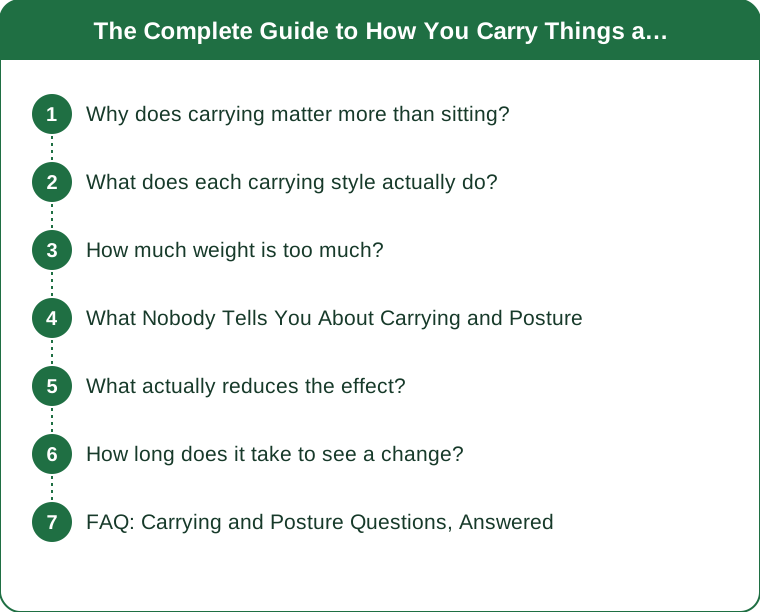
Why does carrying matter more than sitting?
Because carrying applies external load, and load is what drives adaptation.
Sitting badly is a positional problem. It puts tissues in shortened or lengthened positions for long periods, and that does matter. But the forces involved are relatively low, and the body has considerable tolerance for held positions.
Carrying is different. A bag adds mass at a distance from your midline, and your muscles have to generate force continuously to counteract it. That force is applied thousands of times per week in the same direction.
When you carry a bag on your right shoulder, several things happen simultaneously: the right upper trapezius contracts to keep the shoulder elevated and stop the strap sliding, the trunk side-bends left to shift your center of mass over your base, and the deep spinal muscles work asymmetrically to stabilize.
Do that for an hour a day for years and you have a training program. It is a poorly designed one, but it is progressive, specific, and high-frequency, which are the three things that make training effective. Your posture is adapting exactly as it should to the load you are giving it.
This reframe matters because it changes the intervention. If posture were a positional habit, cues and reminders would fix it. Since it is substantially a loading pattern, changing the load is the intervention that works.
What does each carrying style actually do?
Five common patterns, and what each one demands.
Single-shoulder tote or handbag. The most asymmetric option. Requires continuous upper trapezius activation on the carrying side, produces contralateral trunk side-bending, and the heavier the bag the more pronounced both become. People carrying heavy single-shoulder bags frequently develop a visibly elevated shoulder on the carrying side.
Crossbody. Substantially better than single-shoulder because the load is stabilized without shoulder elevation, but still asymmetric. The strap crosses the torso and applies a rotational component, and prolonged use tends to pull one shoulder forward and down.
Backpack, both straps. The best option for load distribution by a wide margin. Load sits close to the spine and is shared. The failure mode is loose straps, which move the load away from the back and increase forward lean.
Backpack, one strap. All the weight of a backpack with all the asymmetry of a single-shoulder bag, and usually heavier than a handbag. This is the worst combination in the list.
Hip-carrying a child. The most demanding by far, because the load is large, dynamic, and carried for extended periods. It shifts the pelvis laterally, requires strong activation of the hip abductors on the opposite side, and produces trunk side-bending toward the carrying side. Parents frequently develop pronounced asymmetry from this and it is rarely discussed as a loading issue.
What matters across all of them is the same three variables: how much, how far from your midline, and how long.
How much weight is too much?
The commonly cited guideline for backpacks is 10 to 15 percent of body weight, derived largely from research on schoolchildren, and it is a reasonable anchor for adults too.
But weight alone is a poor predictor. Distance from your center of mass matters enormously because of leverage. A 5 kg load held close to the spine in a well-fitted backpack is far less demanding than 5 kg hanging from a hand at arm’s length or sitting in a bag that swings behind you.
Duration is the third variable and the one people underestimate. Two kilograms carried for eight minutes is trivial. The same two kilograms carried for ninety minutes daily is a genuine training load, and the tissues adapt accordingly.
A practical way to think about it: load times distance times duration. Reducing any one of the three reduces the total, and it is usually easiest to reduce distance and duration rather than weight, because the things you carry are the things you need.
One useful audit: weigh your everyday bag on a kitchen scale. Most people are carrying between two and six kilograms and have no idea, and about a third of it is things they have not used in a month. Emptying the bag is the fastest intervention available and it requires no behavior change at all.

What Nobody Tells You About Carrying and Posture
Alternating sides does not undo the asymmetry, it just spreads it. This is the most common advice and it is only partly right. Alternating prevents one-sided overload, which is genuinely worthwhile, but most people are strongly dominant and alternate unevenly. If you switch sides and it feels wrong on the non-dominant side, that tells you how uneven the exposure has been.
The strap matters as much as the weight. A narrow strap concentrates pressure over the upper trapezius and the brachial plexus underneath it, which is why thin straps can produce arm tingling that a wider strap with the same weight does not.
Carrying heavy things well is a legitimate exercise. Loaded carries with a symmetric or deliberately asymmetric load are a standard strength training tool, and they build exactly the capacity that makes daily carrying less costly. The difference between a suitcase carry as training and a handbag as damage is intention, duration, and progression.
Phone-in-hand is a carrying pattern too. Holding a phone at chest height for two hours a day is a small sustained load in a forward position, and it is one of the newer contributors to the pattern people call tech neck.
And the one that reframes the whole topic: strength is the variable that determines whether a load is a problem. The same bag that produces symptoms in an untrained person is unremarkable to someone with a strong upper back and trunk. This is why loading interventions outperform postural cueing, and why the answer to “my bag hurts my shoulder” is often to get stronger rather than to buy a different bag.
What actually reduces the effect?
Six changes, ordered by return on effort.
1. Empty the bag. Immediate, free, and usually removes 20 to 40 percent of the weight. Do it monthly.
2. Move to a two-strap backpack for anything over about two kilograms. The single largest structural change available, and the objection is aesthetic rather than practical.
3. Tighten the straps so the load sits high and close. A backpack hanging at the low back has moved the load several inches from your spine, which increases the leverage substantially and produces forward lean. The load should sit between your shoulder blades, not on your hips.
4. Split the load between two hands when carrying by hand. Two bags of equal weight, one per side, is dramatically better than one bag of the same total weight. This is counterintuitive and it is why farmers walk with two implements rather than one.
5. Alternate deliberately, with a rule. Not “when I remember,” which defaults to the dominant side. Something like switching at every intersection, or at the halfway point of a known walk.
6. Train the pattern. Two sets of loaded carries a week, plus rows and other upper back work, changes your tolerance for everything above. Suitcase carries specifically, where you carry weight on one side and resist the side-bend, train exactly the capacity that daily asymmetric carrying demands.
Notice that only one of these six is an exercise. The other five are logistics, and logistics is where most of the available improvement is.
How long does it take to see a change?
Symptoms respond faster than structure, and both respond faster than people expect once the load actually changes.
Neck and shoulder discomfort attributable to carrying often eases within one to two weeks of changing the carrying pattern, because you have removed the ongoing stimulus rather than trying to counteract it.
Visible changes in resting shoulder height or standing asymmetry take longer, typically two to three months, and depend on whether strength work is included. Removing the load stops the progression; building strength changes the baseline.
What does not work on any timeline is postural cueing alone. Research on posture correction consistently finds that conscious correction lasts minutes, because it depends on attention and attention is finite. This is why posture reminders and devices tend to produce short-term compliance and no lasting change.
The realistic expectation: change the carrying, add two strength sessions a week, and give it a season. That is a slower promise than most posture content makes and it is the one that holds up.
This is general information, not medical advice. Numbness, tingling, weakness in the arm or hand, or pain that wakes you at night should be evaluated rather than managed with bag changes.
FAQ: Carrying and Posture Questions, Answered
Is a crossbody bag good or bad?
Better than a single-shoulder tote, worse than a backpack. It is a reasonable compromise for light loads under about two kilograms, and it becomes a problem as weight increases because the rotational component grows with it.
What about carrying a child, where a backpack is not an option?
Use a proper carrier for anything sustained, since a structured carrier distributes across both shoulders and the hips. For short hip-carries, alternate sides with an explicit rule and treat single-leg and side-plank strength work as directly relevant training rather than general fitness.
Do posture correctors help at all?
They provide a tactile reminder and some people find them useful short-term. They do not build the capacity that maintains position, and there is reasonable concern that relying on external support does not encourage the muscles to do the work. Use one as a cue if you like it, not as the plan.
TL;DR:
- Posture adapts to repeated loading, and carrying is the largest asymmetric load in most days
- Single-shoulder bags force shoulder elevation and trunk side-bending; one-strap backpack use is the worst case
- Weight times distance from your midline times duration is the real measure; empty the bag first
- Two straps, high and tight, split hand loads across both sides, and train loaded carries twice a week
Weigh your bag today. Then switch to two straps and pull them tight. That does more for your posture than any exercise you were planning to add.
Keep Reading
This article is for general informational and styling purposes only. Fit, sizing, and product availability may vary.