The Pelvic Tilt Nobody Mentions When They Talk About Fixing Your Posture
Quick Answer: Anterior pelvic tilt — where the pelvis rotates forward, pushing the lower back into an exaggerated arch and the belly slightly forward — is one of the most common and most overlooked drivers of poor posture, and it usually can’t be fixed by shoulder cues alone because the problem starts at the hips, not the upper back.
You can pull your shoulders back a hundred times a day and still look and feel like your posture is off, and for a lot of people the reason is sitting a few inches lower than where everyone’s attention usually goes.
What actually is anterior pelvic tilt, and why does it happen?
Anterior pelvic tilt describes a pelvis that has rotated forward and down at the front, which tips the top of the pelvis forward and tilts the tailbone up and back. The visual signs are a lower back that arches more than it should, a belly that seems to push forward even at a healthy weight, and glutes that look slightly tucked under. It develops gradually, usually from a combination of long hours sitting (which shortens the hip flexors) and a modern lifestyle that rarely asks the glutes and deep core to do their full job of stabilizing the pelvis. Because it builds slowly over months and years, most people never notice the shift happening — they just notice, eventually, that their lower back aches more than it used to, or that their stomach looks different even though nothing else about their body has changed. The tilt itself isn’t dangerous, but the compensations the body makes around it are what eventually cause discomfort, which is why it’s worth understanding even if it’s never been formally diagnosed.
Why don’t shoulder-focused posture fixes touch this problem?
Standard posture advice — pull your shoulders back, lift your chest, imagine a string pulling the crown of your head up — works on the upper body’s positioning relative to the spine, but it does nothing to address what the pelvis is doing underneath. If the pelvis is tilted forward, pulling the shoulders back on top of that tilt just adds a second, disconnected correction layered onto an unresolved base problem, which is exhausting to maintain and rarely sticks because it’s fighting the body’s actual structural starting point. This is a big part of why so many people report that posture cues feel good for the ten seconds they’re actively thinking about it and then evaporate the moment their attention shifts elsewhere. A pelvis that’s chronically tilted forward changes the resting length of muscles all the way up the spine, so the upper body has to work harder just to counteract what’s happening below it, which means shoulder cues are essentially fighting an uphill battle they were never designed to win on their own.
Myth vs Fact: Anterior Pelvic Tilt
Myth: anterior pelvic tilt is mainly a core strength problem, so more crunches will fix it. Fact: it’s usually a combination of tight hip flexors pulling the pelvis forward and underused glutes failing to pull it back, so isolated ab work alone rarely resolves it — the hip flexors and glutes need direct attention too. Myth: everyone with a visible lower back arch has anterior pelvic tilt. Fact: some spinal curve is completely normal and healthy; the tilt becomes a meaningful factor mainly when it’s paired with tightness, discomfort, or a noticeable recent change in how the lower back and hips feel, not just from looking a certain way in a mirror. It’s also worth noting that anterior pelvic tilt is extremely common and not itself a diagnosis of anything wrong — many people have a mild version of it their entire lives with no pain at all, which is why chasing a ‘perfectly neutral’ pelvis isn’t really the goal; comfort and mobility are.

What actually helps correct it, beyond posture cues?
Two muscle groups do most of the heavy lifting here: the hip flexors at the front of the hip, which tend to be tight and need regular stretching, and the glutes at the back, which tend to be underactive and need direct strengthening. A simple daily habit — a 30 to 60 second hip flexor stretch on each side, paired with glute bridges or hip thrusts a few times a week — targets both sides of the imbalance directly, rather than trying to override it with willpower and shoulder position alone. Standing desk breaks, walking more throughout the day, and simply reducing total sitting time also matter, since the hip flexor tightness that drives the tilt is largely a function of how many hours a day they spend in a shortened position. This kind of correction takes weeks rather than days, which is part of why it’s so often skipped in favor of quicker-feeling shoulder cues — but it’s the version of posture work that actually changes the underlying structure instead of layering a temporary fix on top of it.
How would you actually check for this yourself at home?
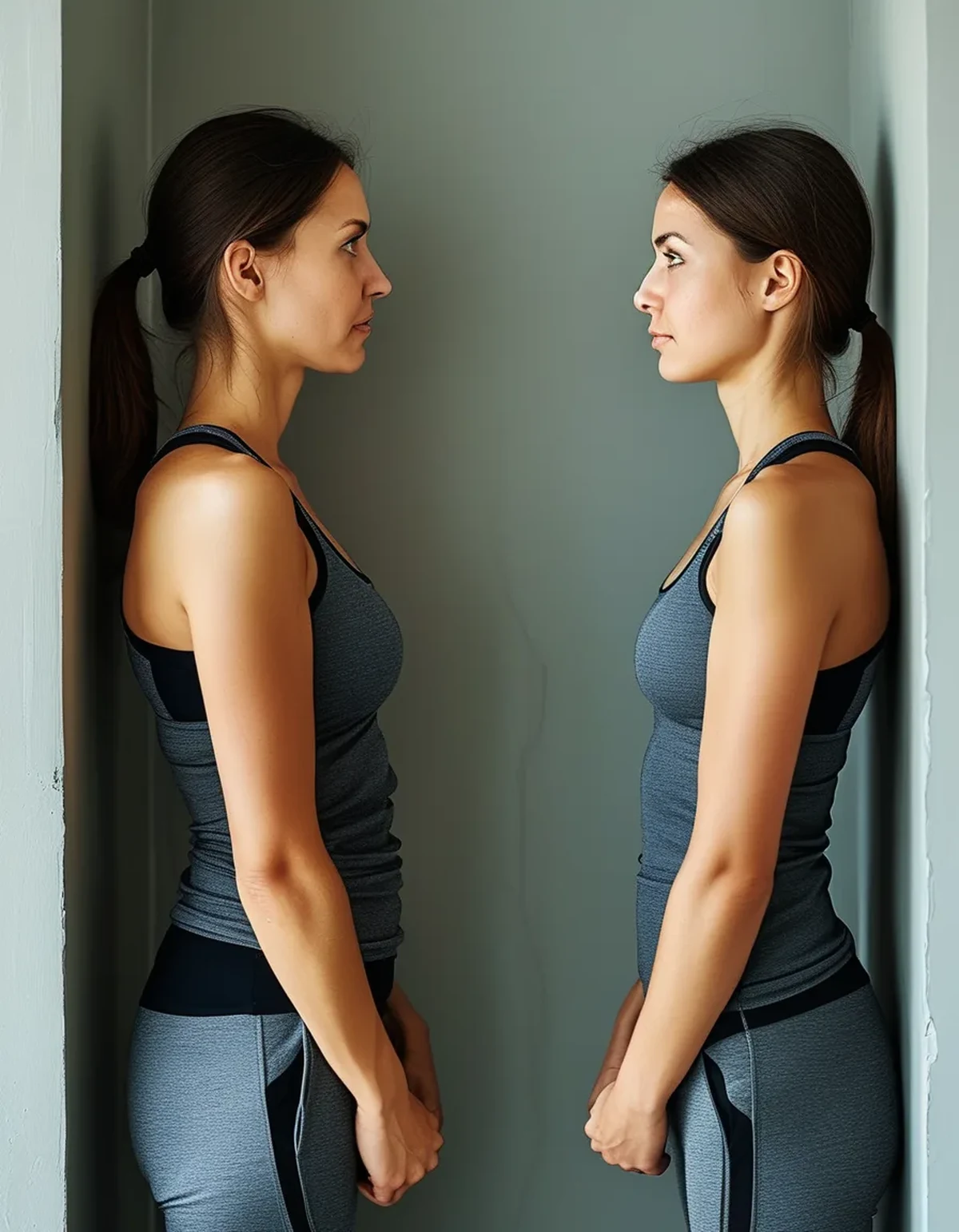
Stand sideways next to a mirror or have someone take a photo, and look at the angle between your lower back and hips — a pronounced inward curve paired with hips that look tipped forward is the classic visual sign, though it’s subtle enough that it often takes a side-by-side comparison to notice. Another simple check: lie flat on your back on a firm floor and slide a hand under your lower back — if there’s a large gap that a flat hand barely fits under with room to spare, that gap is a rough indicator of how much forward tilt is present, since a neutral pelvis on a flat surface leaves only a small natural curve. Neither check is a medical diagnosis, but both give a reasonable sense of whether this is worth addressing, and both can be repeated every few weeks to track whether hip flexor and glute work is actually changing anything over time.
Does this connect to any of the other common posture complaints?
Yes — a forward-tilted pelvis changes the resting position of the entire spine above it, which is one reason people working on rounded shoulders or tech neck sometimes plateau even when they’re doing the right upper-body exercises. The spine is a connected chain, and a base that’s tilted forward tends to pull the mid and upper back into compensations that make upper-body-only fixes feel like they stall out. This is also part of why some people report that their posture ‘doesn’t stick’ even after weeks of consistent shoulder and neck work — the piece they were missing was several vertebrae lower than where they were looking. Addressing the pelvis first, or at least alongside upper-body work, tends to make every other posture fix land more effectively and last longer.
FAQ: Anterior Pelvic Tilt Questions, Answered
Is anterior pelvic tilt the same as lower back pain?
No — the tilt is a positional pattern, not a diagnosis, and plenty of people have a mild tilt with zero pain; it becomes relevant mainly when it’s paired with actual discomfort or a noticeable recent change.
How long does it take to see a difference from hip flexor and glute work?
Most people notice a change in how their lower back feels within 3 to 6 weeks of consistent daily stretching and a few weekly glute sessions, though visual changes in posture take longer.
Should I see a physical therapist for this instead of doing it myself?
A physical therapist is worth seeing if there’s pain involved, since they can rule out other causes and build a targeted plan — for tilt without pain, the general hip flexor and glute approach here is a reasonable starting point. This is general information, not medical advice.
TL;DR:
- Anterior pelvic tilt is a forward rotation of the pelvis that shoulder-only posture cues can’t fix
- It usually comes from tight hip flexors paired with underactive glutes, often from long sitting hours
- A simple check: lying flat and checking the gap under your lower back with a hand
- Daily hip flexor stretching plus regular glute strengthening addresses the actual root cause
- Fixing the pelvis first often makes upper-body posture work finally stick
If your posture fixes keep not lasting, the missing piece might be several vertebrae lower than you’ve been looking.
Keep Reading
This article is for general informational and styling purposes only. Fit, sizing, and product availability may vary.